Registered Nurse Resume Examples & Templates [2026]

Want to land your dream nursing job? A well-crafted Registered Nurse resume is your key to standing out! In this guide, you’ll find expert tips, real resume examples, and a nurse resume template to help you highlight your skills in patient care, medication administration, and electronic health records. Learn how to showcase your qualifications effectively and get noticed in today’s competitive nursing job market.
With over 5 million RNs competing nationwide, hospitals filter applications using keyword scans before a hiring manager ever sees them. If your resume isn’t optimized, it won’t get read.
In this guide, you’ll find ATS-friendly Registered Nurse resume examples, proven formatting tips, and a ready-to-use template designed to highlight your clinical skills, certifications, and measurable patient outcomes — so you can land more interviews in 2025.
Key Takeaways
- Use a reverse-chronological format for most RN roles
- Include a strong summary with credentials, specialization, and measurable impact
- Quantify achievements (e.g., reduced readmissions by 15%)
- Add high-value nursing keywords like patient care, EMR, medication administration, infection control
- List licenses and certifications clearly (RN, BSN, CCRN, CPN, etc.)
- Tailor your resume to each job description to pass ATS filters
- Keep it clean, professional, and 1–2 pages max
How to Write a Registered Nurse Resume (Step-by-Step Guide)
Here are 8 helpful steps for writing a nursing resume:
- Step 1: Choose an ATS-Friendly Registered Nurse Resume Template
- Step 2: Add Contact Information the Right Way
- Step 3: Write a Strong Registered Nurse Resume Summary (With Examples)
- Step 4:Showcase Your Nursing Experience (With Examples)
- Step 5: Add Top Registered Nurse Skills
- Step 6: List Licenses, Certifications, and Nursing Degrees
- Step 7: Tailor Your RN Resume to the Job Description
- Step 8: Include a Registered Nurse Cover Letter (Optional)
Step 1: Choose an ATS-Friendly Registered Nurse Resume Template
When creating a nurse resume, it can be helpful to use a template that is specifically designed for nursing professionals.
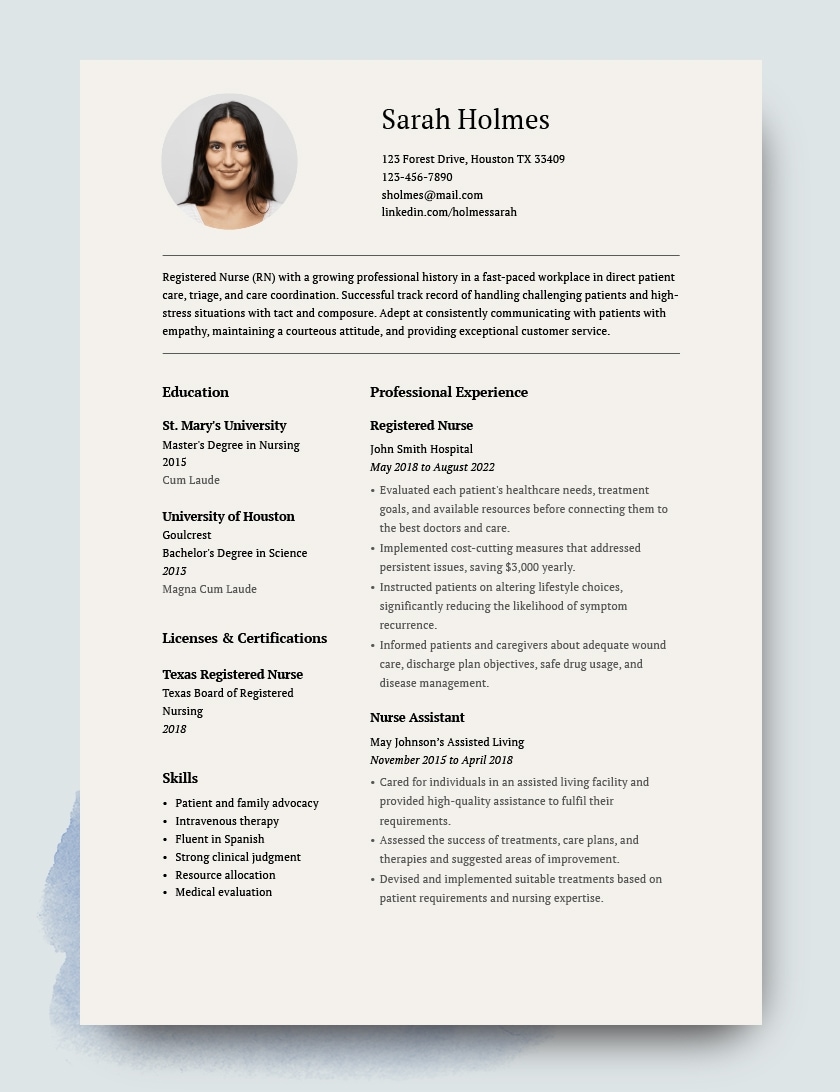
Registered Nurse Resume Template 150020
Get your RN template now →
Remember, using a nurse CV template can provide a solid foundation for creating your resume, but it’s important to customize it to showcase your unique qualifications and experiences.
Step 2: Add Contact Information the Right Way
- Place your contact information at the top of your resume so that it is easily visible to employers.
- Use a larger font size for your name to enhance its visibility and make it stand out.
- Format the rest of your contact details in a way that is clear and easy to read. You can place them in one or two lines below your name.
- Avoid placing your contact information in the header section of a Word document, as not all applicant tracking systems can properly read and parse information stored in this section.
Related: Resume Headline Examples: Stand Out from the Crowd
Step 3: Write a Strong Registered Nurse Resume Summary (With Examples)
Your resume summary should quickly highlight your qualifications, experience, and key skills in a compelling way. Follow these tips:
- Start strong – Use an engaging opening with action verbs to showcase your nursing expertise.
- Highlight key qualifications – Mention your nursing degree, certifications, and specialized training.
- Showcase experience – Summarize your work settings (e.g., hospitals, clinics) and notable achievements with quantifiable results.
- Emphasize patient care – Demonstrate your commitment to compassionate, patient-centered care and advocacy.
- Include relevant skills – Feature essential nursing skills like clinical assessment, medication administration, and teamwork.
Example #1: Senior-Level Profile
Example #2: Entry-Level Profile
Related: Resume Summary Examples [+How-to Guide]
Step 4: Showcase Your Nursing Experience (With Examples)
A well-crafted nurse work experience section is essential for a standout resume. It allows you to showcase your relevant work experience and accomplishments in the field. To make the most impact, keep these tips in mind:
- Focus on achievements: Instead of simply listing your responsibilities, highlight your accomplishments and the impact you made in your previous roles. For example, mention any improvements in patient outcomes, successful implementation of new protocols, or recognition you received for your work.
- Quantify your impact: Whenever possible, include numbers or percentages to quantify your achievements. For instance, mention the number of patients you cared for, the success rates of treatments you administered, or any awards or recognition you received.
- Tailor to the job description: Review the job description and identify the key skills and qualifications the employer is seeking. Customize your experience section to highlight how your previous roles align with those requirements.
- Include specialized experience: If you have experience in a particular specialty or have worked in different healthcare settings, such as hospitals, clinics, or home healthcare, be sure to highlight that experience. It can help you stand out from other applicants.
Example #1: Senior-Level Professional Experience
St. Mary’s Medical Center, Chicago, IL / March 2018 – Present
- Oversaw patient care management for a 30-bed acute care unit, ensuring seamless coordination between physicians, nurses, and support staff to optimize patient outcomes
- Developed and implemented evidence-based nursing protocols that improved patient recovery rates by 15% and reduced hospital readmissions
- Mentored and trained a team of 20+ junior nurses and LPNs, fostering professional development and ensuring adherence to best practices in patient care
- Led initiatives to improve clinical workflow efficiency, reducing medication administration errors by 20% through enhanced training and compliance audits
Example #2: Entry-Level Professional Experience
Registered Nurse
Brookdale Community Hospital, Miami, FL / July 2022 – Present
- Provided direct patient care, including medication administration, wound care, and vital sign monitoring, ensuring adherence to hospital policies and safety protocols
- Assisted in developing individualized care plans by collaborating with physicians and senior nurses to address patient needs effectively
- Educated patients and families on post-discharge care instructions, leading to a 12% decrease in hospital readmission rates
- Maintained accurate and detailed patient records in the electronic medical records (EMR) system, ensuring seamless communication among healthcare providers

Related: 60+ Resume Summary Examples for 2025 [+How-to Guide]
Step 5: Add Top Registered Nurse Skills
When creating a successful nurse resume, it’s important to include a combination of technical (hard skills) and soft skills that demonstrate your expertise and suitability for the role.
| Key Nursing Skills | ||
|---|---|---|
| Time Management | Clinical Assessment | Vital Monitoring |
| Communication | Medication Administration | Pain Management |
| Leadership Skills | Basic Life Support | Charting and Documentation |
| Emotional Support | Patient Education | Cultural Competence |
| Empathy and Compassion | Infection Control | Nutrition Management |
| Critical Thinking | Wound Care | Patient Safety |
| Team Collaboration | IV Therapy | Blood Draw |
Related: 20+ Best Nursing Skills for Your Resume [2025]
Step 6: List Licenses, Certifications, and Nursing Degrees
Degrees
- List your highest degree first (e.g., Bachelor of Science in Nursing (BSN), Master of Science in Nursing (MSN)).
- Use full degree names rather than abbreviations.
- Arrange multiple degrees in reverse chronological order.
Certifications & Licenses
- Include certifications relevant to the job, such as Certified Pediatric Nurse (CPN), Certified Emergency Nurse (CEN), or Certified Critical Care Nurse (CCRN).
- List nursing licenses (e.g., Registered Nurse (RN), Licensed Practical Nurse (LPN)).
- Use proper credentials after your name when applicable (e.g., DNP, PMHNP-BC).
Step 7: Tailor Your RN Resume to the Job Description
- Review the job description – Identify key qualifications and incorporate relevant keywords.
- Customize your summary – Align your professional summary with the role by emphasizing matching skills and experience.
- Highlight relevant skills – Include both technical skills (e.g., wound care, patient education) and soft skills (e.g., teamwork, problem-solving).
- Focus on key experience – Prioritize responsibilities and achievements that directly relate to the position.
- Showcase certifications – List specializations such as Critical Care (CCRN), Pediatrics (CPN), or Geriatrics (RN-BC).
- Quantify achievements – Use numbers to demonstrate impact, like reducing patient wait times by 15% or managing care for 20+ patients daily.
Related: How to Write Resume Job Description in 6 Steps [+ Examples]
Step 8: Include a Registered Nurse Cover Letter (Optional but Recommended)
When writing a cover letter for a registered nurse position, consider the following tips:
- Introduction: Start with a strong opening paragraph that states your interest in the position and briefly highlights your qualifications and experience. Mention how you learned about the job opening.
- Body Paragraphs: In the following paragraphs, expand on your relevant skills, experiences, and accomplishments. Focus on how your qualifications align with the requirements of the job. Use specific examples to demonstrate your abilities and showcase your passion for nursing.
- Closing: In the closing paragraph, express your enthusiasm for the opportunity to contribute to the healthcare team. I would like to express my sincere appreciation for considering my application I am eager to provide any additional information or references that might be required.
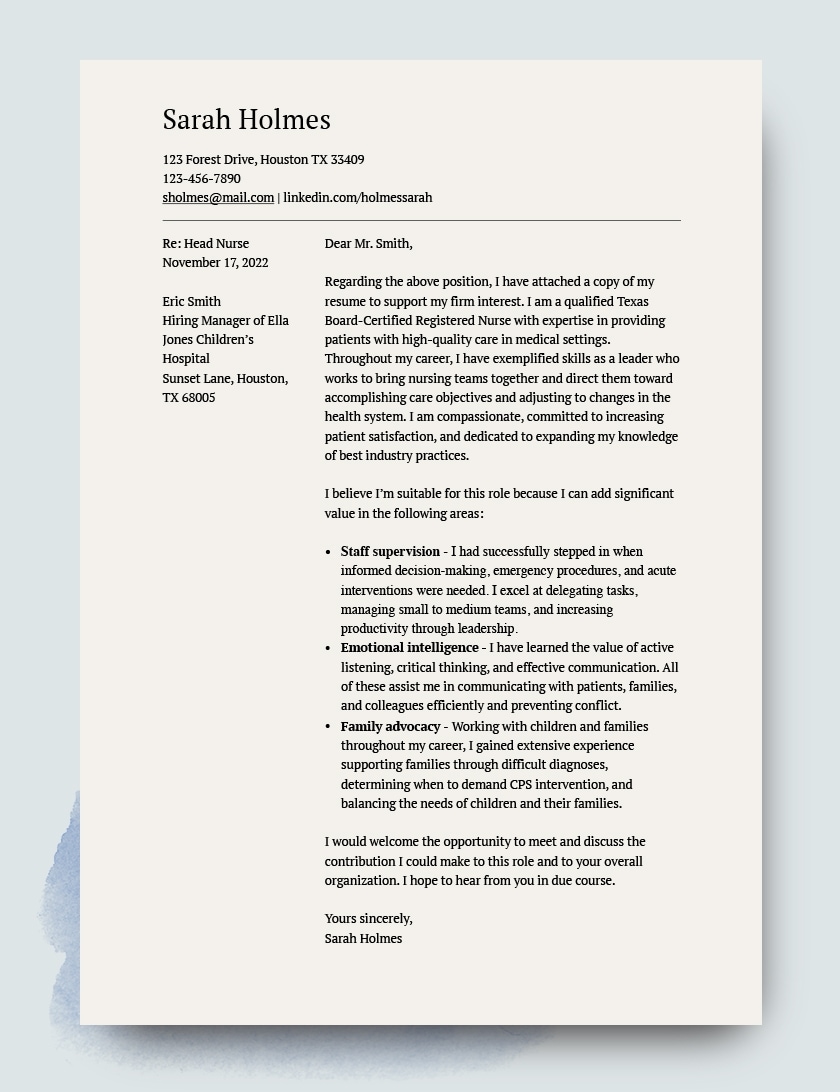
Registered Nurse Cover Letter Template 150020
Download it here →
How to Choose the Best Registered Nurse Resume Template
Selecting the right nurse resume template is essential to making a strong first impression. A clean, well-structured template ensures that your qualifications, experience, and skills remain the focal point. Avoid designs with excessive graphics or distracting colors, as they can shift attention away from your achievements. Instead, opt for a professionally designed, easy-to-read template that highlights your expertise effectively.
For polished and ATS-friendly resume templates, explore these expertly crafted resume templates to enhance your job search.
More Resume Examples & Templates for Inspiration:
- How to write a resume with examples & templates
- How to write a resume with no work experience & examples
- Project manager resume examples & templates
- Computer science resume examples & templates
- Attorney resume examples & templates
- Creative director resume examples & templates
- Customer service resume examples & templates
- Graphic designer resume examples & templates
- Best Microsoft Word Resume Templates
Registered Nurse Resume FAQ
How long should a Registered Nurse resume be in 2026?
A Registered Nurse resume should ideally be one page for entry-level nurses and up to two pages for experienced RNs. Keep it concise while including all relevant clinical experience, certifications, and key skills.
Should I include certifications and licenses on my Registered Nurse resume?
Yes. Including your RN license, state-specific credentials, and certifications such as BLS, ACLS, or specialty nursing certificates strengthens your resume. Place them in a dedicated “Certifications & Licenses” section to make it easy for employers to verify your qualifications.
What is the best format for a Registered Nurse resume?
The chronological format is generally preferred, as it highlights clinical experience and career progression. A hybrid format can also work if you want to emphasize key skills alongside work history. Use clear headings, bullet points for duties, and consistent formatting to make your resume professional and readable.
How can I make my Registered Nurse resume ATS-friendly?
To optimize your resume for Applicant Tracking Systems (ATS), use standard headings like “Experience,” “Education,” and “Skills,” and avoid tables, graphics, or unusual fonts. Incorporate keywords from the job description naturally in your experience and skills sections. Save your file as a .docx or PDF to ensure it is parsed correctly, and focus on concise bullet points with measurable achievements.
Popular related posts:
- 22 Nursing Interview Questions, Answers and Tips To Prepare
- Project Manager Resume Examples & Templates
- 40+ Resume Headline Examples: Stand Out from the Crowd
- Resume Objective Examples for 2025 [+How-to Guide]
- How To Write a Cover Letter With No Experience in 9 Steps
 Privacy Protected
Get a Free Expert Resume Review
file here or click to upload
Thank You