12 Hardest Interview Questions [+ How to Nail Your Answers]
Ever walked out of an interview replaying that one brutal question in your head?
You’re not alone. Questions like “What’s your biggest weakness?” or “Why should we hire you?” are among the hardest and trickiest interview questions—even for experienced professionals.
In fact, 47% of hiring managers use tough questions to assess how well you handle pressure and think on your feet (LinkedIn). Often, it’s not a lack of experience that costs candidates the job, but a small interview mistake or not knowing what not to say in an interview.
In this guide, we’ll break down 12 of the hardest interview questions—and show you exactly how to answer them with confidence, clarity, and authenticity.
TL;DR
- The hardest interview questions are usually behavioral, testing how you handled real situations.
- Use the STAR method to structure clear, results-focused answers.
- Emphasize measurable impact, growth, and accountability.
- Avoid vague answers or speaking negatively about past employers.
- Prepare thoughtful questions to show engagement and strategic thinking.
12+ Hardest interview questions and how to answer them
Here are some of the toughest interview questions and tips to help you answer them effectively.
- 1. Why should I hire you?
- 2. Tell me about yourself
- 3. How do you handle conflict?
- 4. What is your biggest failure?
- 5. Describe yourself in 3 words.
- 6. What’s your greatest weakness?
- 7. How do you work under pressure?
- 8. Where do you see yourself in 5 years?
- 9. Why are you leaving your current job?
- 10. What are your salary expectations?
- 11. How do you handle constructive criticism?
- 12. What can you do for us that other candidates can’t?

1. Why should I hire you?
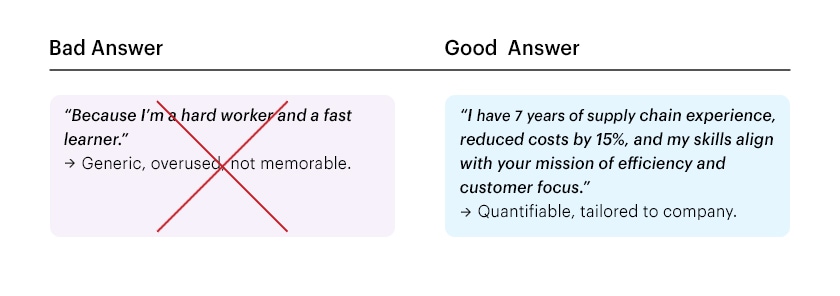
This question is your chance to show the interviewer how well you align with the company’s goals and why you’re the best fit for the role.
Here’s how to craft a strong answer:
- Emphasize your value: Share specific accomplishments that highlight your most relevant skills and strengths.
- Connect to the role: Explain how your experience directly meets the company’s needs and solves their challenges.
- Show results: Use numbers or outcomes to demonstrate your impact in past roles.
- Tailor your pitch: Align your answer with the job description and company values to show you’re not just qualified—you’re the ideal fit.
Example answer (for a role at Amazon):
“You should consider hiring me because I bring a unique blend of skills, experience, and mindset that align perfectly with Amazon’s mission of customer obsession and operational excellence. I have 5 years of experience in supply chain management, during which I reduced operational costs by 15% by optimizing vendor relationships and streamlining processes. Additionally, my adaptability and problem-solving skills have allowed me to thrive in fast-paced environments, something Amazon values greatly. I am not only passionate about driving results but also fostering innovation, which aligns with your leadership principles.”
Read more: Why Should We Hire You? 3 Step Guide to the Best Answer
2. Tell me about yourself
Here’s a suggested approach:
- Start with a brief personal introduction: Begin by sharing your name and a brief overview of your background, such as your education and any relevant certifications.
- Highlight your professional experience: Discuss your previous roles and experiences, focusing on those that are most relevant to the position you’re applying for. Mention key accomplishments, responsibilities, and skills you developed in each role.
- Connect your experience to the job: Emphasize how your experiences align with the position’s requirements, mentioning specific projects or achievements.
- Discuss your strengths and qualities: Share a few key strengths or qualities that make you a standout candidate, like technical skills or leadership abilities.
- Wrap up with your career goals: Conclude by discussing your future aspirations and how this role fits into your career objectives, expressing your excitement to contribute to the company.
Example answer (for a role at Google):
“I am a data-driven marketing professional with over 6 years of experience in digital strategy and analytics. My journey began in a startup, where I led a small team to design SEO strategies that increased traffic by 30% in one year. I moved on to a larger firm where I specialized in product marketing for SaaS companies, improving client acquisition rates by 20%. I’ve always been passionate about solving complex problems with innovative digital solutions, and Google’s commitment to using data to improve user experience deeply resonates with me. I’m now looking for the next step in my career, where I can apply my skills to drive even more impactful results in a global company like Google.”

Read more: Tell Me About Yourself” Tips and Example Answers
3. How do you handle conflict?
Here are some tips for effectively answering questions about conflict:
- Describe your approach to conflict resolution: Start by sharing how you typically handle conflict—focus on open communication, listening, and resolving issues constructively.
- Provide an example: Give an example where you de-escalated a conflict by listening, finding common ground, and guiding the team toward a resolution.
- Highlight your skills: Emphasize the skills you utilized during the conflict resolution process. These can include effective communication, empathy, problem-solving, negotiation, and the ability to remain calm and composed under pressure.
- Use STAR technique to clearly explain how you resolved the issue. This is a core strategy in behavioral interview answers, helping you stay structured and focused.
- Discuss the outcome: Share the positive outcome that resulted from your conflict resolution efforts. Explain how the resolution improved working relationships, productivity, or the overall work environment.
- Reflect on lessons learned: Conclude your response by reflecting on what you learned from the experience and how it has shaped your approach to handling conflicts. Mention any strategies or techniques you have since adopted to prevent or address conflicts proactively.
4. What is your biggest failure?
Interviewers ask this to assess your accountability and ability to grow. Keep your answer honest and forward-looking: briefly explain the failure, take responsibility, and focus on what you learned and how you’ve improved. Choose an example that shows growth without raising concerns about your job performance.
Example answer:
“While I believe in focusing on growth and learning from past experiences rather than dwelling on failures, I can share an example of a setback that I encountered. In a previous project, I underestimated the amount of time required for a particular task, which resulted in delays in the overall project timeline. However, I took immediate action by communicating the issue to the team and reallocating resources to mitigate the impact. I also implemented better project planning and estimation techniques moving forward. This experience taught me the importance of thorough planning, effective communication, and the ability to adapt to unexpected challenges.”
Why this example answer works
This answer works because it demonstrates accountability, self-awareness, and growth—exactly what interviewers look for when asking about failure. The candidate briefly explains the mistake, takes responsibility, and avoids blame, while focusing on lessons learned and improvement. The example is realistic, non-damaging to job performance, and highlights key skills such as communication, planning, and adaptability.
5. Describe yourself in 3 words.
When describing yourself, think of your best personality and professional traits. Also, check what the company is looking for and make sure your characteristics align. Finally, use easy-to-understand but original adjectives that will make you stand out.
Example answer:
If I were to describe myself in three words, I would say I am adaptable, diligent, and empathetic.
- Adaptability is a trait that allows me to quickly adjust to new situations and challenges. I am open to change and thrive in dynamic environments, which enables me to effectively navigate through various projects and tasks.
- Diligence is another key aspect of my personality. I am committed to giving my best effort in everything I do. I am detail-oriented, organized, and proactive, ensuring that I complete tasks efficiently and effectively.
- Lastly, empathy plays a vital role in my interactions with others. I genuinely care about people’s experiences and perspectives, allowing me to connect with them on a deeper level. This empathy helps me understand their needs and concerns, fostering strong relationships and effective teamwork.
These three traits not only define me as an individual but also shape my approach to work and relationships.
6. What’s your greatest weakness?
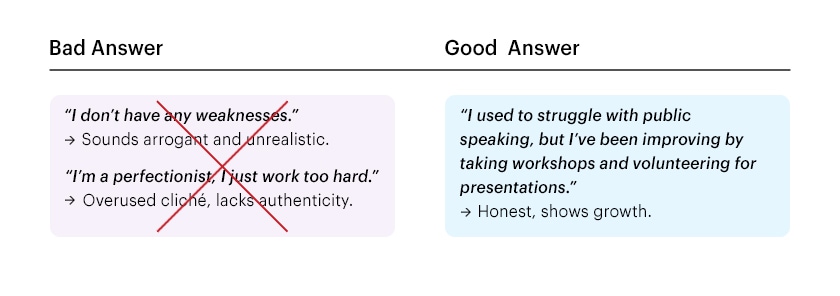
Responding to “What’s your greatest weakness?” – often considered one of the hardest interview questions – requires a thoughtful approach. You want to be honest without damaging your candidacy, and show that you’re actively working to improve. Here’s how to structure your response:
- Be Honest, but strategic: Pick a weakness that isn’t essential to the role. For example, if you’re applying for a project management position, avoid saying you’re disorganized.
- Highlight self-awareness: Demonstrating that you’re aware of your weaknesses shows maturity and a growth mindset.
- Show progress: Emphasize what you’re doing to improve. Employers appreciate candidates who are proactive about self-improvement.
Examples:
- “One area I’ve been working on is my tendency to take on too much at once. I like to help out whenever possible, but I’ve learned to prioritize tasks better and delegate when necessary.”
- “I used to struggle with public speaking, but I’ve been actively working on it by volunteering for presentations and taking communication workshops.”
- “I’ve started using productivity tools to manage my workload better, which has significantly improved my efficiency.”
Read more: Strengths and Weaknesses for Job Interviews in 2024 [Best Answers]
7. How do you work under pressure?
At some point, you will likely experience stressful situations in any position. That’s why interviewers want to learn more about your techniques for managing stress and pressure. This question is your opportunity to show that you can still get your work done even under tight deadlines or stressful circumstances. To assure the hiring manager that you can handle pressure, follow these steps:
- Think about what you usually do to avoid or handle stress.
- Use an example of when you excelled in your work even under pressure.
- Share whether stress ever motivates you and pushes you to do a great job.
Example answer:
“When faced with pressure, I thrive on the challenge and use it as an opportunity to showcase my skills. I stay calm and focused by breaking down tasks into smaller, manageable steps. I prioritize effectively, ensuring that critical tasks are completed first. Additionally, I maintain open communication with my team, seeking their support and input when needed. By staying organized, managing my time efficiently, and collaborating effectively, I have consistently delivered high-quality work, even under tight deadlines.”
8. Where do you see yourself in 5 years?
Interviewers often ask this question to gauge how the position aligns with your long-term career goals. Employers seek candidates who are eager to grow within the company, rather than those likely to leave for other opportunities. Even if you don’t have a detailed 5-year plan, you can craft a response that demonstrates your commitment to the company’s future. Here’s how:
- Think about your career goals and the steps that could take you there.
- Research growth opportunities within the company you’re applying to.
- Find out if your goals align with the company’s vision.
- Demonstrate why you are worth the time and investment as a new employee.
Read more: How to Answer “Where Do You See Yourself in 5 Years?”
9. Why are you leaving your current job?
Keep your answer positive, professional, and focused on the future. Avoid speaking negatively about your current employer or job, as this can reflect poorly on you. Instead, focus on career growth, new opportunities, and alignment with your goals. Some of the best examples of reasons for leaving a job include:
- Looking for career growth
- Seeking new challenges
- Looking to change career paths
- Relocation to a new city
- The company going out of business
- Being laid off or let go
Example answer:
“I’ve enjoyed my time at my current position and learned a great deal, but I feel that I’ve reached a point where there are limited opportunities for growth. I’m ready to take on new challenges that align with my career goals and offer more room for professional development.”
Why this example answer works
This answer works because it maintains a positive, professional, and forward-looking tone—key factors interviewers evaluate when asking why a candidate is leaving a job. The response avoids negative commentary about the current employer and instead focuses on career growth and alignment with long-term goals. This approach demonstrates maturity, motivation, and intentional career decision-making without raising concerns about performance or workplace issues.
Read more: How to Answer “Why Are You Leaving Your Current Job?”
10. What are your salary expectations?
Discussing salary expectations can be one of the most challenging aspects of an interview. You want to avoid setting your expectations too low and risk being undervalued, but aiming too high could result in being overlooked due to cost concerns. The key to addressing this question effectively is thorough research and demonstrating flexibility.
Begin by researching the standard salary range for the role you’re applying for. When responding, provide a range instead of a fixed figure to show adaptability. Additionally, express that your expectations are flexible and open to negotiation.
If you’re uncomfortable providing a specific number or wish to elaborate, you might consider responding along these lines:
Example answer:
“Based on my research and understanding of the industry standards and the responsibilities of this role, I am seeking a salary range between $X and $Y. However, I am open to discussing the specifics and considering the overall compensation package, including benefits and opportunities for growth within the company. I believe in the value I can bring to this position and I am confident that we can come to a mutually beneficial agreement.”

Read more: How to Answer, “What Are Your Salary Expectations?”
11. How do you handle constructive criticism?
This question often shows up in tough job interviews to evaluate emotional intelligence. Make your behavioral interview answers reflect your growth mindset and adaptability.
Example answer
“I see constructive criticism as an essential part of personal and professional growth. When I receive feedback, I focus on understanding the key points and view it as an opportunity to improve. My first step is to listen carefully and ask clarifying questions if needed to ensure I fully understand the feedback. Then, I reflect on how I can incorporate those insights into my work. For example, in my previous role, after receiving feedback on improving my project management skills, I took steps to implement better organizational tools and communication methods, which resulted in smoother project delivery. I believe that embracing feedback helps me continuously evolve and perform at a higher level.”
Why this example answer works
This answer works because it demonstrates emotional intelligence, openness to feedback, and a strong growth mindset—core traits interviewers assess when asking about constructive criticism. The candidate listens, reflects, and takes action, rather than responding defensively. The inclusion of a specific outcome reinforces adaptability, coachability, and professional maturity.
12. What can you do for us that other candidates can’t?
Here’s how you can approach this question:
- Identify relevant skills: Highlight specific skills that make you uniquely qualified for the role. Emphasize how these skills align with the company’s needs and contribute to its success.
- Share past experience: Provide examples of past experiences where you have demonstrated the skills and qualities that differentiate you from other candidates. Use specific achievements to showcase your capabilities.
- Quantify your impact: Whenever possible, quantify the impact of your contributions in previous roles. This could include measurable results or outcomes that demonstrate your value to potential employers.
Example answer (for a role at Tesla):
“What sets me apart from other candidates is my combination of technical engineering expertise and my entrepreneurial mindset. With a background in mechanical engineering and 4 years of hands-on experience in electric vehicle (EV) technology, I not only understand the intricacies of EV systems but also how to innovate within this space. For example, I led a project in my previous role that reduced battery degradation by 8%, which resulted in longer vehicle lifespans and increased customer satisfaction. I’m also highly attuned to Tesla’s culture of continuous innovation, and my proactive, solutions-oriented approach will contribute to Tesla’s mission of accelerating the world’s transition to sustainable energy.”
13. Do you have any questions for me?
At the conclusion of the hardest interview questions, when the interviewer asks, “Do you have any questions for me?”, it presents a valuable chance to demonstrate your genuine interest in both the company and the role. It’s also an excellent moment to gather key insights that will help you make a well-informed decision should you receive an offer.
Here are a few thoughtful questions you might consider asking.
- Could you provide additional information about the daily tasks and responsibilities associated with this position?
- What are the main goals or priorities for the team/department/company right now?
- How would you describe the company culture and values?
- Can you share any opportunities for growth or advancement within the company?
- What is the usual career path for someone in this role?
- How does the company promote professional development and continuous learning?
- Can you tell me about the team I would be working with?
- What challenges or opportunities do you foresee in the near future for the company/industry?
- How does the company promote work-life balance?
- What are the next steps in the interview process?
Related: 20+ Common Interview Questions & Answers in 2024
Hardest behavioral interview questions
Behavioral interview questions require more than just remembering a story — they demand structure, self-awareness, and impact. That’s why using the STAR technique and refining your answers through mock interviews is essential. Strong delivery, confident body language, and knowing how to impress in an interview often set great candidates apart.
14. Tell me about a time you failed. How did you handle it?
Example answer:
“At the start of my career as a project manager, I was responsible for overseeing a team to ensure the successful completion of a vital project for a client. Early on, I underestimated the complexity of the project and failed to allocate enough resources to certain critical tasks. As deadlines approached, we were behind schedule, and the client was unhappy. I took full responsibility, met with the client to apologize, and explained the steps we were taking to correct the issue. I also reorganized the team’s workflow, added extra resources, and reprioritized tasks to catch up. Although we ended up delivering the project later than expected, the client appreciated our transparency and the improved quality of work. That failure taught me the importance of proactive planning and managing expectations early on.”
15. Describe a time when you faced a significant challenge at work. How did you handle it?
Example answer:
“A significant challenge I encountered involved overseeing the transition to a new software system across the company. My department was struggling to adapt to the new system, which led to a drop in productivity and frustration among the team. I took the initiative to lead the transition by organizing regular training sessions, providing one-on-one support, and developing quick reference guides. I also coordinated with the IT department to resolve any technical issues more efficiently. Through consistent communication and hands-on support, we were able to stabilize productivity within a few weeks, and our department became one of the highest-performing groups using the new software.”
16. Tell me about a time you had a conflict with a coworker. How did you resolve it?
Example answer:
“At my previous job, I had a conflict with a coworker over the approach to a client’s project. They preferred a traditional method, while I wanted to use a more innovative solution that I believed would save time and money. The tension began to affect team morale. I invited them to a one-on-one meeting, where I listened to their concerns and explained my perspective in detail. We realized that while our approaches were different, we shared the same goal. Eventually, we combined elements from both strategies, which led to a successful project outcome. This experience taught me the value of open communication and compromise.”
17. Tell me about a time when you had to make a difficult decision with limited information.
Example answer:
“As a product manager, I was faced with a tough choice regarding the launch of a new feature, despite being under significant time constraints. The issue was that our market research was incomplete, but we were under pressure to release. I gathered all available data, consulted with key stakeholders from marketing, sales, and engineering, and considered the potential risks and benefits. Ultimately, I decided to proceed with the launch but set up a backup plan to address any issues that arose. The feature had a few initial bugs, but we quickly resolved them, and it turned out to be one of our most popular releases. This experience taught me the importance of calculated risk-taking and being prepared for contingencies.”
These are classic behavioral interview questions that hiring managers use to uncover your real-life performance. Practicing with mock interviews can help you refine your responses and gain confidence before the real thing.
Read more: 41+ Behavioral Interview Questions and Answers in 2024

How to prepare for tough interview questions
Preparing for tough interview questions requires strategy, practice, and self-reflection. Here’s a guide to help you approach this with confidence:
1. Research the company and role
- Know the job description: Understand the key responsibilities and required skills. This will help you anticipate what challenging questions might be asked related to the role.
- Study the company’s culture and values: Knowing the company’s mission, values, and industry will help you align your answers with their expectations.
2. Practice common difficult interview questions
Some of the most challenging questions fall into these categories:
- Behavioral interview questions: These often start with, “Tell me about a time when…” Prepare examples using the STAR method (Situation, Task, Action, Result) to clearly explain how you handled a difficult situation.
- Problem-solving interview questions: Employers may present hypothetical situations or real problems you could face in the role. Focus on breaking down your thought process and showing how you’d solve the issue.
- Questions about weaknesses: Be ready to discuss your weaknesses or mistakes. Focus on what you’ve learned from those experiences and how you’ve improved.
- Conflict or leadership challenges: Be prepared to discuss how you’ve handled difficult colleagues, challenging leadership situations, or made decisions under pressure.
While this guide covers common tough questions, it’s also important to focus on how you deliver your responses. Techniques like mock interviews, practicing with the STAR technique, and mastering your body language can make a major difference—not only in structuring strong behavioral interview answers, but also in learning how to impress in an interview.
However, terms like “behavioral interview answers,” “STAR technique,” “body language,” “mock interviews,” are still underused by many job seekers—even when preparing for behavioral questions. Including and understanding these concepts can significantly strengthen your interview performance.
3. Prepare and practice your key messages
- Know your strengths: Be ready to speak confidently about your skills, experiences, and accomplishments. Tailor your responses to demonstrate how these align with the role.
- Frame your weaknesses positively: When discussing weaknesses or past mistakes, emphasize personal growth and the steps you’ve taken to improve.
- Stay positive: Avoid speaking negatively about previous employers or experiences. Focus on what you learned or how challenges helped you grow.
4. Prepare your own questions
According to Jenn Bouchard, former Global Head of Talent at Meta: “If candidates don’t have follow-up questions that they’ve pulled through from the interview … that’s a red flag. It shows disinterest and a lack of engagement.” This insight reflects how hiring managers evaluate engagement, not just answers. Interviews are reciprocal assessments — your curiosity signals strategic thinking and cultural alignment.
Instead of asking generic questions like “What does the company do?”, try:
- “What does success look like in the first 90 days?”
- “What challenges is the team currently facing?”
- “How do top performers in this role differentiate themselves?”
Read more: Job Interview Preparation: Step-by-Step Guide 2025
FAQ
Why do employers ask tough interview questions?
Employers use tough questions to assess critical skills like problem-solving, resilience, creativity, and the ability to perform under pressure. These questions also help gauge your self-awareness and alignment with the company’s values and goals.
How can I prepare for difficult interview questions?
Start by researching common hard questions and practicing your responses. Use the STAR method (Situation, Task, Action, Result) to structure behavioral answers and focus on showcasing your skills, adaptability, and problem-solving abilities.
How do you answer tricky interview questions without experience?
Focus on the skills and experiences you do have instead of the ones you lack. Highlight transferable abilities such as teamwork, communication, or problem-solving, and use examples from school, volunteering, or personal projects. Show enthusiasm to learn and adapt—employers value potential and a growth mindset just as much as direct experience.
What are red flag answers in interviews?
Red flag answers are responses that raise concerns about your professionalism, attitude, or fit for the role. These include speaking negatively about past employers, giving overly vague or generic answers, admitting to skills that are essential for the job as weaknesses, or showing little enthusiasm for the position. Avoid answers that sound dishonest, rehearsed, or self-centered—interviewers are looking for authenticity, positivity, and alignment with the company’s values.
Popular related posts:
- Strengths and Weaknesses for Job Interviews [Great Answers]
- “Why are You Leaving Your Current Job?“ 4 Best Answers
- Thank You Email After Interview: Examples, Dos, and Don’ts
- 7 Ways to Improve Your Cover Letter Today
 Privacy Protected
Get a Free Expert Resume Review
file here or click to upload
Thank You