
How to Use Storytelling to Ace Job Interviews in 2026

I’ve worked with hundreds of leaders and professionals to help them tell effective stories that open doors—whether that’s stepping into leadership roles, landing new jobs, increase in sales or salary, earning media features, or speaking on influential stages. As a TEDx speaker, TEDx curator, and TV show host, I’ve seen firsthand how powerful storytelling is when it connects clearly, demonstrates problem-solving, and makes impact easy to understand.
In interviews, that skill matters more than most candidates realize. When interviewers ask, “Tell me about a time when…”, many people respond with answers that are vague, overly detailed, or unfocused. Instead of spotlighting leadership or results, their stories drift—and the value gets lost.
Drawing on my experience as a storytelling coach, TEDx curator, and bestselling author of Speak With Influence, this guide breaks down how to use proven frameworks like STAR and CAR to tell stories that connect, showcase your problem-solving and leadership skills, and clearly position you as the strongest candidate for the role.
Key Takeaways:
Use structured storytelling frameworks like STAR or CAR to answer behavioral interview questions clearly and confidently. Prepare 3–5 measurable stories that showcase your problem-solving, leadership, and results in under 90 seconds. Strong storytelling makes you more memorable and positions you as the strongest candidate.
Why Storytelling Matters in Job Interviews
Storytelling in job interviews matters because it turns experience into clear, memorable examples. Instead of vague answers, a short story shows how you think, solve problems, and deliver results.
Behavioral interview questions are designed to assess past performance. Structured stories help interviewers quickly understand your actions, decisions, and impact—making your answers easier to evaluate and remember.
Clear storytelling also highlights communication skills, confidence, and creative problem-solving. By showing how you resolve challenges and deliver results without unnecessary escalation, you help employers see how you would perform in real job situations.
Related: Answering ‘Tell Me About Yourself’ in an Interview in 2026

Key Interview Storytelling Techniques
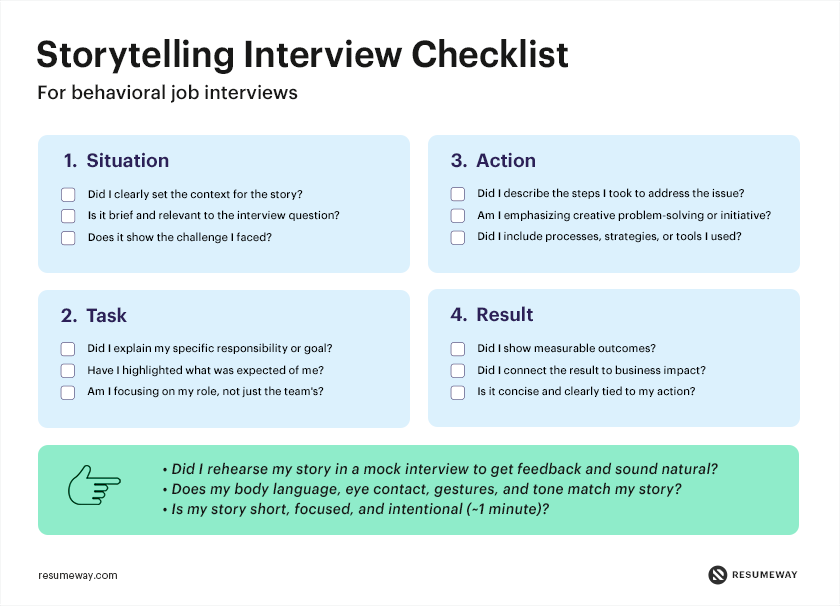
To craft strong and memorable interview stories, focus on using clear, structured methods:
- STAR Method (Situation, Task, Action, Result)
- This framework is ideal for creating powerful STAR method interview stories.
- Situation: Set the context.
- Task: Explain your responsibility or goal.
- Action: Describe the steps you took.
- Result: Highlight the measurable outcome or impact.
- CAR Method
- Challenge: Define the problem or obstacle.
- Action: Outline what you did to address it.
- Result: Show the outcome and what you achieved.
- Interview Storytelling Tips That Impress Hiring Managers
- Keep your stories concise—aim for about one minute.
- Choose examples closely related to the job.
- Focus on your individual contributions.
- Use specific details and numbers to make results stronger.
Related: Strengths and Weaknesses for Job Interviews in 2026 [Best Answers]
Examples of Storytelling in Interviews
Below are storytelling examples that show how to use STAR or CAR to highlight problem-solving, leadership, and impact. Pick stories that directly answer the question and clearly show your skills. Make them relatable, so interviewers can see your solutions and impact. Keep each story short, focused, and intentional—avoid rambling. Every sentence should show why you’re the right candidate.
1.“Tell me about a time you faced a challenge…”
Example Story #1: Project Management Challenge
Situation: At my previous company, we were two weeks behind on a software release due to misalignment between the engineering and design teams.
Task: As the project coordinator, I needed to realign both teams and recover lost time without sacrificing quality.
Action: I organized a joint sprint-planning session, clarified ownership for each task, and created a shared dashboard with real-time updates. I also introduced 10-minute daily standups to address blockers immediately.
Result: We recovered the two-week delay and launched on the original release date. Post-launch defects dropped by 18% compared to the previous version.
2. “Describe a situation where you showed leadership…”
Example Story #2: Leadership in Customer Success
Situation: Our team noticed a recurring drop in client engagement after the first 60 days of onboarding.
Task: As a senior customer success associate, I wanted to reduce churn by improving the early customer journey.
Action: I led a small cross-functional group to analyze user behavior. We discovered customers struggled with advanced features. I created a new onboarding flow with video walk-throughs and a live Q&A session.
Result: Within three months, engagement at the 60-day mark increased by 42%, and churn dropped by 15%. Management rolled out my onboarding process company-wide.
3. “Tell me about a time you solved a problem creatively…”
Example Story #3: Creative Problem-Solving in Marketing
Challenge: Two months before a major product campaign, our marketing budget was cut by 30%, leaving us with limited funds to drive awareness.
Action: I launched a user-generated content challenge, partnered with three industry micro-influencers, and repurposed existing blog content into short-form videos to maximize reach without extra cost.
Result: The campaign reached 120,000 people- 20% more than the previous year’s campaign with a larger budget and generated a 7% conversion rate.
4. “Tell me about a time you improved a process…”
Example Story #4: Process Improvement in Operations
Challenge: Our warehouse team averaged 12 order fulfillment errors per week, causing delays and increased costs.
Action: I redesigned the pick-path sequence based on item frequency, added color-coded bins for top-selling products, and trained the team on the new layout to streamline workflow.
Result: Fulfillment errors dropped from 12 to 3 per week within one month, saving about $4,500 per month in returns and reshipping costs.
Tip: Highlight how you improved processes or systems—employers value candidates who make workflows more efficient and reduce recurring problems.
Related: 12 Hardest Interview Questions [+ How to Nail Your Answers]
Tips to Perfect Your Interview Storytelling
One of the most effective job interview storytelling tips is to practice your stories out loud so they sound natural, not memorized. Keep each story focused on one main point and aim for about a one‑minute answer to stay concise.
Choose examples that directly relate to the skills the employer wants, and highlight your personal contribution rather than the team’s. Use specific details, results, and numbers to make your story more memorable.
Storytelling in interviews isn’t just about what you say—how you say it matters too. Research on non‑verbal communication shows that in face‑to‑face interactions, only a small portion of your message comes from words, while tone of voice and body language play an outsized role in how you’re perceived. In situations involving emotional cues like interviews, body language and tone can collectively make up a large share of how others interpret your message, so make sure your posture, eye contact, gestures, and tone all match the confident, clear story you’re telling.
Finally, rehearse 3–5 strong stories you can confidently adapt to different questions so you’re prepared and composed under pressure.
Related: How To Build a Personal Brand in 2026 (Step-by-Step Strategy)
FAQ:
How many stories should I prepare for a job interview?
It’s best to prepare 3–5 strong stories that cover key competencies like leadership, problem-solving, teamwork, conflict resolution, and achievement. These core stories can be adapted to different interview questions, so you don’t need a new story for every prompt.
How do I create strong storytelling examples for interviews?
Start by identifying situations where you made a measurable impact or overcame a challenge. Then use the STAR or CAR method to structure your story clearly. Choose specific details, highlight your individual contribution, and tie the result to what the employer values. Practicing these structured stories helps you turn them into powerful, memorable interview examples.
How long should a STAR or CAR answer be in an interview?
Ideally, your answer should be 60–90 seconds. This gives enough time to explain the situation and highlight results without losing the interviewer’s attention. Keep the situation brief, focus on your actions, and clearly state measurable outcomes. If more detail is needed, interviewers will ask follow-up questions.
What are the most common storytelling mistakes to avoid in job interviews?
- Making stories too long or cluttered with unnecessary details
- Choosing examples that don’t match the role
- Using vague results or skipping measurable outcomes
- Relying on hypothetical scenarios instead of real experiences
- Sounding overly memorized or failing to highlight your contribution
Avoiding these mistakes keeps your stories focused, authentic, and persuasive.
 Privacy Protected
Get a Free Expert Resume Review
file here or click to upload
Thank You
