How to Write a Letter of Recommendation (Templates & Examples)
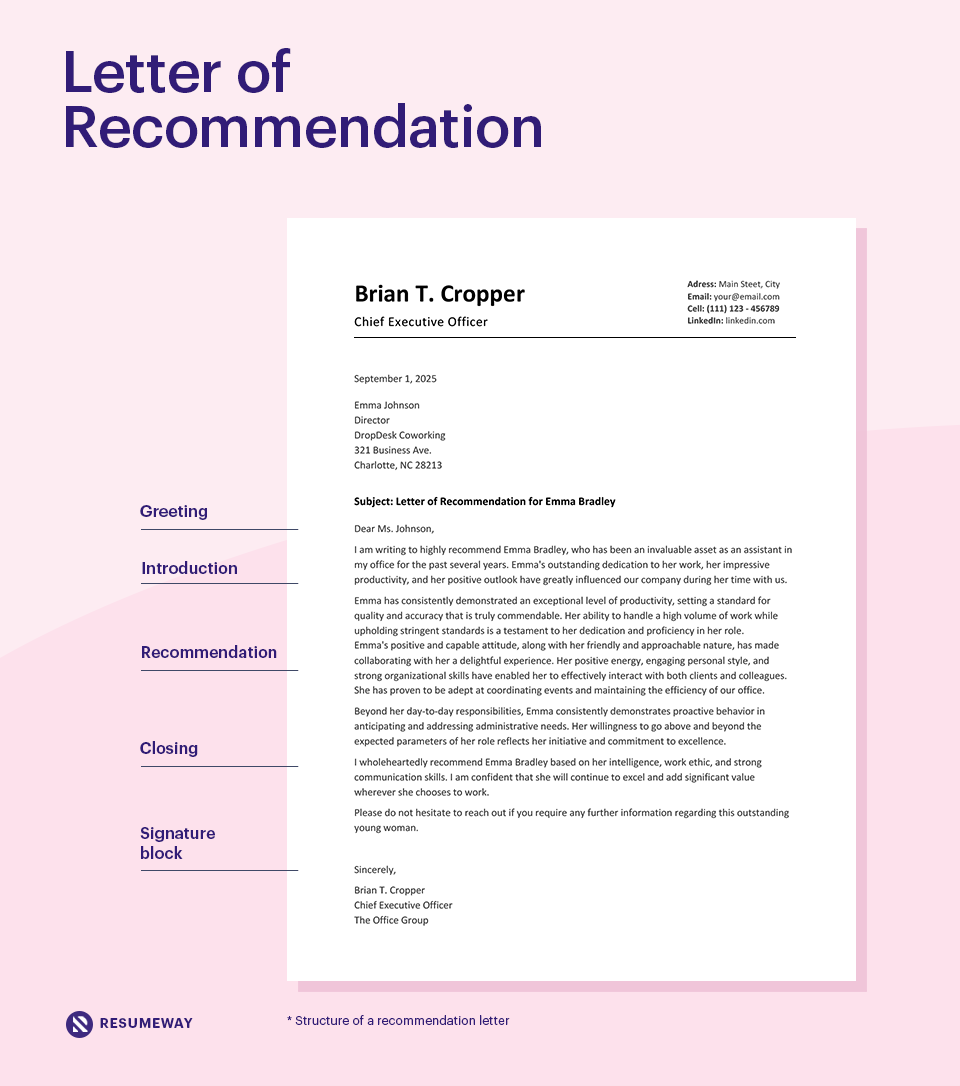
A strong letter of recommendation can significantly impact a candidate’s chances—but most letters fail to make an impression.
Why? Because they rely on generic praise instead of specific, credible examples.
Based on real-world experience reviewing recommendation letters for job applications, college admissions, and scholarships, the most effective letters follow a clear structure, use measurable achievements, and align closely with the opportunity.
In this guide, you’ll learn how to write a letter of recommendation step by step, including what to include, what to avoid, and examples you can use immediately.
Table of contents
What is a letter of recommendation?
A letter of recommendation is a written endorsement that highlights a person’s skills, achievements, and character, typically written by someone who has directly worked with them—such as a teacher, employer, or mentor.
It is commonly used to support applications for jobs, universities, internships, or scholarships, offering a credible, third-party perspective on the candidate’s abilities, work ethic, and potential.
Letter of recommendation vs reference letter
Although the terms are often used interchangeably, there is a key difference:
- Letter of recommendation: Tailored to a specific opportunity and more detailed
- Reference letter: General and reusable across multiple applications
Using the right type ensures the letter meets the expectations of the recipient.
Related: How to Make a Resume in 2026 [Step-by-Step Guide]
Step-by-step: How to write a letter of recommendation
1. Understand the purpose and audience
Before you write anything, clarify what kind of recommendation you’re being asked to provide. A letter for a job application is very different from one for academic admission or a scholarship.
- Job applications: Focus on workplace skills, reliability, teamwork, and measurable performance.
- Academic applications: Emphasize intellectual ability, curiosity, research potential, and classroom engagement.
- Scholarships: Highlight leadership, impact, character, and alignment with the scholarship’s mission.
Also consider who will read the letter. Admissions committees and hiring managers look for different signals, so tailoring your tone and examples is essential.
2. Open with credibility
Start by clearly establishing who you are and why your opinion carries weight. This builds trust in your evaluation of the candidate.
Include:
- Your job title and organization
- Your relationship to the candidate
- How long you’ve known them and in what capacity
Example framing:
“I have worked with [Name] for three years as their direct supervisor at [Company], where I lead the marketing department.”
This section should be concise but authoritative.
3. Highlight key strengths with proof
Avoid vague praise like “hardworking” or “smart” without evidence. Instead, connect traits to concrete examples and outcomes.
Strong letters include:
- Specific achievements (projects completed, grades, promotions)
- Quantifiable results (percent improvements, rankings, KPIs)
- Observable behaviors (problem-solving, leadership in action)
Example:
“She improved team efficiency by 32% by redesigning our workflow system.”
Proof transforms general praise into credible endorsement.
4. Add a standout story (experience signal)
A short narrative makes your letter memorable and more persuasive. This is where you show—not just tell—what the candidate is capable of.
A strong story typically includes:
- A challenge or context
- The candidate’s action
- The outcome or impact
Example structure:
During a critical product launch, [Name] took ownership of a failing timeline, coordinated cross-functional teams, and delivered the project ahead of schedule.
Stories help the reader visualize the candidate in action.
5. Align candidate with opportunity
One of the most important (and often overlooked) parts of a recommendation letter is tailoring it to the specific role, program, or award.
Make explicit connections:
- Match candidate skills to job requirements or academic goals
- Reflect language from the application when appropriate
- Emphasize traits most relevant to success in that context
For example:
“Her analytical skills and research experience make her an excellent fit for a data-driven graduate program.”
This alignment significantly increases the letter’s effectiveness.
6. Close with a strong endorsement
End with a clear, confident recommendation. Avoid hesitation or weak phrasing.
Include:
- A direct endorsement (e.g., “I highly recommend…”)
- Optional offer to provide further information
- Your contact details if appropriate
Example:
“I strongly recommend [Name] without reservation for this position and am confident they will excel. Please feel free to contact me for additional information.”
A strong closing reinforces trust and leaves a lasting impression.
Related: Types of Resumes: The Best Formats to Stand Out in 2025
Strong vs weak recommendation letter
Strong recommendation letter
- Specific examples of performance and impact
- Measurable results (e.g., “increased sales by 30%”)
- Clear relationship between writer and candidate
- Tailored to the specific role or program
- Confident, direct endorsement (“highly recommend”)
Weak recommendation letter
- Generic praise (“hardworking,” “nice,” “team player”)
- No concrete examples or results
- Unclear or distant relationship
- Reused, non-specific content
- Neutral or vague language (“recommend,” “should do well”)
Good vs Bad Example
“Sarah is a hardworking and responsible student. She is always on time and works well with others.”
“Sarah ranked in the top 5% of her class and led a team project that improved lab efficiency by 30%. Her ability to organize complex data and guide her peers made her one of the most effective student leaders I’ve worked with.”
Related: Best Resume Format for 2025 [Pros and Cons]
Letter of recommendation examples
Below are several sample letters of recommendation tailored for students, employees, and scholarship applications. These letter of recommendation examples can guide your tone, structure, and content.
Letter of Recommendation for Student
Dear Admissions Committee,
I am pleased to recommend Sarah Thompson, whom I taught in AP Biology and advised in the Science Club.
Sarah ranked in the top 5% of her class and led an independent research project on plant microbiomes, which earned top honors at the regional science fair. She consistently demonstrated strong analytical skills and the ability to apply complex concepts in practical settings.
Beyond academics, Sarah volunteers at a local nature center, where she teaches younger students about environmental science.
I highly recommend Sarah for your program. She will be a valuable addition to your academic community.
Sincerely,
[Name]
Why this works:
- Specific achievements (top 5%, award)
- Clear relationship (teacher + advisor)
- Shows impact beyond classroom
Letter of Recommendation for an Employee
Dear Hiring Manager,
I recommend Alex Ramirez, who worked under my supervision as a Marketing Associate for three years.
Alex led multiple campaigns that increased customer engagement by 40% and played a key role in launching a product that exceeded revenue targets in its first quarter. He combines strong analytical skills with creativity and consistently delivers under tight deadlines.
He is also a reliable team player who supports colleagues and communicates effectively with clients.
I highly recommend Alex for this role.
Sincerely,
[Name]
Why this works:
- Quantified results (40% increase)
- Role and duration clearly stated
- Direct business impact
Letter of Recommendation for Scholarship
Dear Scholarship Committee,
I am honored to recommend Mia Patel, whom I have worked with as a school counselor for the past two years.
Mia maintains a 4.0 GPA while serving as class president and volunteering weekly at a local food pantry. She also organized a school-wide mental health awareness initiative, demonstrating leadership and initiative.
Her commitment to both academic excellence and community service makes her an outstanding candidate for this scholarship.
I strongly recommend Mia for your program.
Sincerely,
[Name]
Why this works:
- Balanced profile (academics + leadership + service)
- Clear credibility (counselor role)
- Relevant to scholarship criteria
Related: How to List Professional References on a Resume [+Examples]
Recommendation letter templates
Use the following recommendation letter templates to quickly create professional-looking letters. Each sample letter of recommendation is editable and designed for different use cases, such as employment, college admissions, and scholarships.
Letter of recommendation sample for student
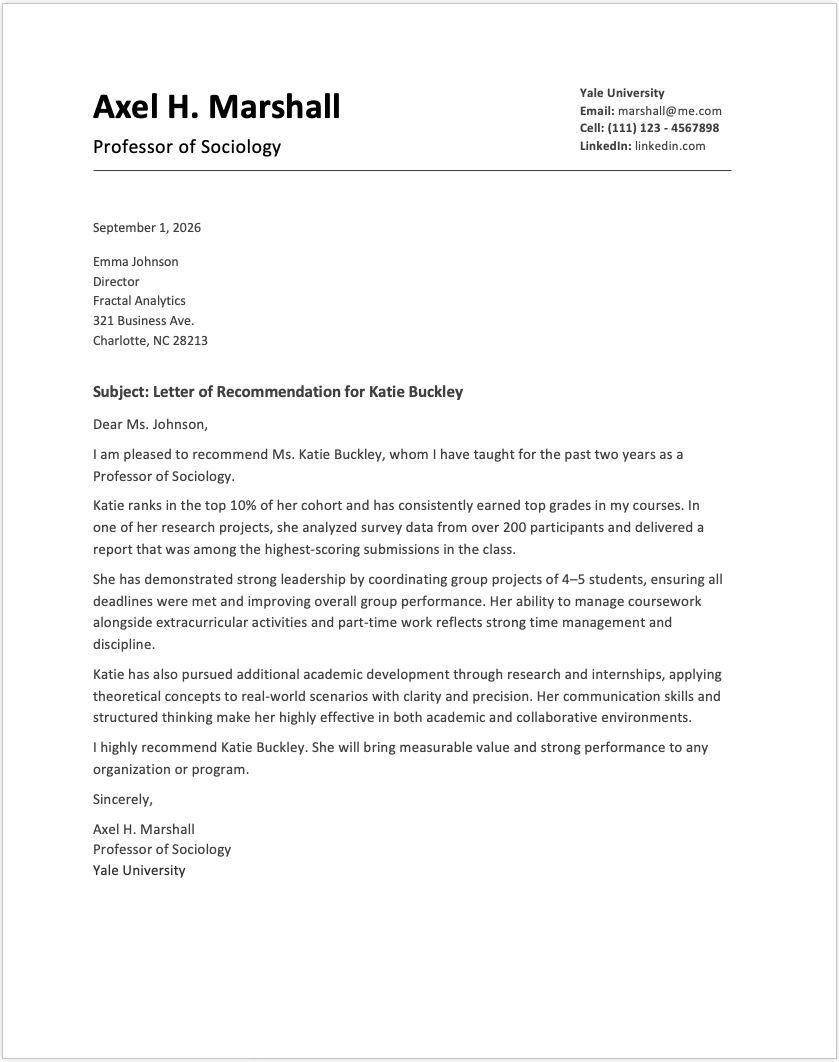
[Download Student Recommendation Template (Word)]
Copyable template:
Subject: Letter of Recommendation for Katie Buckley
Dear Ms. Johnson,
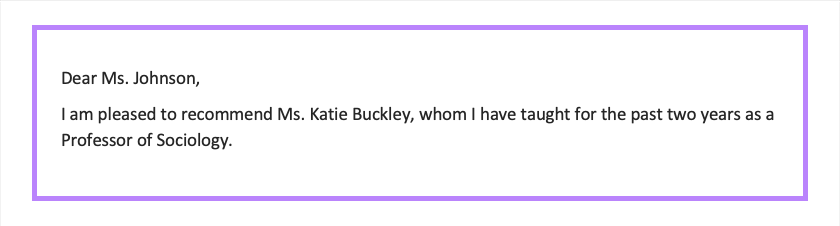
I am pleased to recommend Ms. Katie Buckley, whom I have taught for the past two years as a Professor of Sociology.
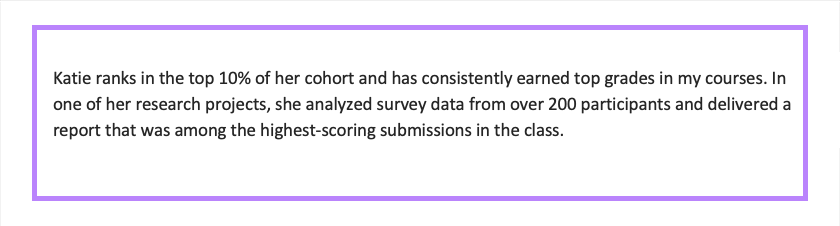
Katie ranks in the top 10% of her cohort and has consistently earned top grades in my courses. In one of her research projects, she analyzed survey data from over 200 participants and delivered a report that was among the highest-scoring submissions in the class.
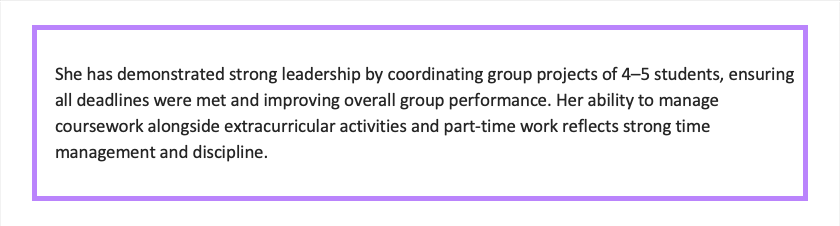
She has demonstrated strong leadership by coordinating group projects of 4–5 students, ensuring all deadlines were met and improving overall group performance. Her ability to manage coursework alongside extracurricular activities and part-time work reflects strong time management and discipline.
Katie has also pursued additional academic development through research and internships, applying theoretical concepts to real-world scenarios with clarity and precision. Her communication skills and structured thinking make her highly effective in both academic and collaborative environments.
I highly recommend Katie Buckley. She will bring measurable value and strong performance to any organization or program.
Sincerely,
Axel H. Marshall
Professor of Sociology
Yale University
Letter of recommendation sample for employee
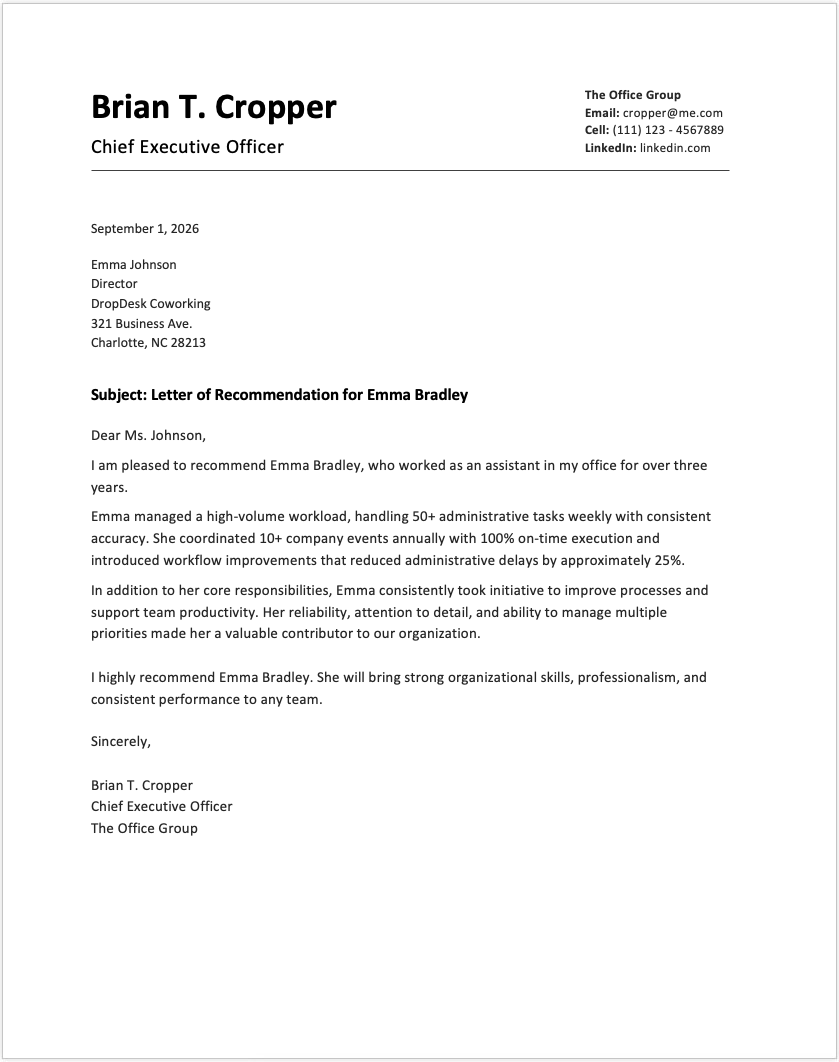
[Download Employee Recommendation Template (Word)]
Copyable template:
Subject: Letter of Recommendation for Emma Bradley
Dear Ms. Johnson,
I am pleased to recommend Emma Bradley, who worked as an assistant in my office for over three years.
Emma managed a high-volume workload, handling 50+ administrative tasks weekly with consistent accuracy. She coordinated 10+ company events annually with 100% on-time execution and introduced workflow improvements that reduced administrative delays by approximately 25%.
In addition to her core responsibilities, Emma consistently took initiative to improve processes and support team productivity. Her reliability, attention to detail, and ability to manage multiple priorities made her a valuable contributor to our organization.
I highly recommend Emma Bradley. She will bring strong organizational skills, professionalism, and consistent performance to any team.
Sincerely,
Brian T. Cropper
Chief Executive Officer
The Office Group
How to ask for a letter of recommendation
Choose someone who knows your work well and can speak positively about your skills, character, or achievements. This might be a teacher, manager, mentor, or colleague.
When reaching out, be clear and respectful. Explain what the letter is for, why you’re asking them, and how their insight will help support your application. Share context about the opportunity (e.g., job, scholarship, program) and remind them of specific projects or qualities they’ve seen in you.
Always give enough notice—ideally two to three weeks—so they have time to write a thoughtful letter. Being prepared, courteous, and specific increases the chances of receiving a strong, personalized recommendation.
Hiring manager insights
- What admissions officers actually look for
From reviewing recommendation letters across academic applications, one pattern stands out: specific examples consistently carry more weight than general praise. Admissions teams want to see how a candidate actually thinks, works, and contributes. - How recruiters actually read letters
In most hiring processes, recommendation letters are skimmed, not fully read. Recruiters typically check who wrote the letter first, then scan for clear signals of impact—something concrete that shows the candidate delivers results. - What makes a letter stand out instantly
The strongest letters get to the point quickly. They include at least one specific, memorable example and make the level of recommendation clear. - When a letter can hurt a candidate
A vague or overly safe letter can weaken an application. Generic wording or lack of detail often signals that the recommender doesn’t have strong evidence to support the candidate.
Related: How To Write a Cover Letter With No Experience in 9 Steps [2025]
FAQ
Can a bad recommendation letter hurt you?
Yes. A weak or vague recommendation letter can hurt your chances because it fails to clearly support your qualifications. If the letter lacks specific examples, measurable achievements, or a strong endorsement, it can make your application less competitive.
What should NOT be included in a recommendation letter?
A recommendation letter should not include generic statements, irrelevant personal details, or exaggerated claims without evidence. These elements reduce credibility and make the letter less persuasive to reviewers.
How long should a letter of recommendation be?
A strong letter of recommendation is typically 300–500 words. It should be long enough to include specific examples and context, but short enough to remain focused, clear, and easy to read.
Who should I ask for a letter of recommendation?
You should ask someone who knows your work directly and can provide specific, positive examples of your performance. This is usually a teacher, manager, internship supervisor, or mentor who has closely observed your skills.
What makes a recommendation letter stand out?
A recommendation letter stands out when it includes specific examples, measurable achievements, and confident, detailed endorsement. The strongest letters clearly explain what you did, how well you did it, and why it matters.
Popular related posts:
 Privacy Protected
Get a Free Expert Resume Review
file here or click to upload
Thank You