25 Manager Interview Questions (With Sample Answers)

Preparing for a management interview in 2026 requires more than memorizing generic answers. Employers now evaluate leadership judgment, emotional intelligence, conflict resolution, strategic thinking, and measurable business impact. This guide covers 25 real manager interview questions with sample STAR answers, leadership frameworks, and expert-backed strategies to help you stand out.
Key Takeaways
- 25 real manager interview questions with sample answers
- Covers behavioral, situational, and leadership questions
- STAR method used to structure strong responses
- Focuses on leadership, decision-making, and conflict resolution
- Includes smart questions to ask the interviewer
- Helps you answer clearly, confidently, and with real examples
- Prepares you for practical, real-world management interviews
What Interviewers Are Actually Testing
After participating in dozens of management hiring panels, one pattern becomes obvious: candidates who only describe responsibilities rarely stand out. The strongest candidates explain how they handled pressure, influenced difficult team dynamics, and improved measurable business outcomes.
Most Common Manager Interview Questions
1. Tell me about yourself as a manager
Interviewers ask this question to evaluate your leadership experience, communication skills, and management approach. They want to understand how you lead teams, solve problems, and deliver results
“I’m a results-focused manager with experience leading a team of 12 in operations and client delivery. In my last role, I introduced weekly 1:1 check-ins and set clearer KPIs for each role so expectations were easier to track. I also improved how we organized and tracked work by switching to a shared project board, which made priorities more visible across the team.
After a few months, we cut missed deadlines from about 18% to under 5%, improved on-time delivery from 82% to 96%, and saw fewer escalations from clients. Team feedback also improved, and turnover dropped noticeably over the same period”
Why this answer is strong
- Uses measurable results to prove leadership impact and business improvement.
- Demonstrates key management skills like communication, delegation, and team leadership.
- Shows initiative by solving workflow and performance challenges proactively.
- Balances operational success with positive team development and morale.
2. Why do you want this management position?
Hiring managers ask this question to evaluate how you lead teams, delegate responsibilities, communicate expectations, and adapt to different employee personalities.
“I’m interested in this management position because it gives me the opportunity to combine leadership, problem-solving, and team development. I enjoy helping employees grow, improving processes, and creating a positive work environment where people can perform at their best. I’m motivated by the challenge of leading a team toward shared goals while contributing to the overall success of the company.”
Common mistakes:
- Focusing only on personal career growth, salary, or job title benefits.
- Giving generic answers that do not connect to leadership responsibilities or company goals.
- Failing to explain how your management approach benefits both the team and the organization.
- Sounding overly rehearsed without showing genuine motivation for leading and developing people.
3. What is your management style?
Employers ask this question to understand how you lead employees, delegate work, communicate expectations, and manage performance. They also want to see whether your leadership style fits the company culture.
“My management style is collaborative and goal-oriented. I believe in setting clear expectations, supporting employees when needed, and giving team members the autonomy to perform their best work. I focus on open communication, accountability, and continuous improvement while creating an environment where employees feel valued and motivated.”
Common mistakes:
- Giving overly generic leadership traits without real management context or examples.
- Describing a management style that is too rigid or overly controlling.
- Focusing only on authority instead of communication, support, and team development.
- Using buzzwords like “people person” or “results-driven” without explaining how those qualities appear in day-to-day leadership.
4. How do you motivate employees?
Interviewers ask this question to assess your ability to keep employees engaged, productive, and focused on goals. They want to see how you improve morale, recognize performance, and support employee growth.
“I motivate employees by recognizing their contributions, providing clear goals, and creating opportunities for growth. I’ve found that employees perform best when they understand how their work contributes to the company’s success. I also believe regular feedback, strong communication, and celebrating achievements help maintain high morale and productivity.”
Why this answer is strong
- Shows a balanced, practical approach to motivating employees (recognition, goals, growth, feedback).
- Connects motivation directly to performance and business outcomes.
- Demonstrates real leadership practices like communication and continuous feedback.
- Reflects understanding of employee engagement and purpose-driven work.
Management Style & Experience Questions
6. How do you demonstrate leadership skills in your work?
“In my previous role as a manager, there was a major project that required cross-functional collaboration. I took the initiative to bring various teams together, set clear goals, and delegate tasks based on individual strengths. I ensured open communication, provided guidance and support, and motivated the team to stay focused and meet the project deadline. As a result, we successfully completed the project on time and exceeded our client’s expectations.”
Why this works:
The answer shows you understand what motivates people and how to build a high-performing team, which signals strong emotional intelligence and leadership maturity.
7. What do you believe is the most important quality of a leader?
Sample Answer:
“I think adaptability is the key quality for a leader. The ability to assess situations, adjust approaches, and remain open to feedback allows leaders to navigate challenges and guide their teams effectively. This flexibility, paired with strong communication and empathy, builds trust and respect within the team, creating a collaborative and dynamic work environment where everyone can thrive.”
8. How do you describe your management style?
“I would describe my management style as both collaborative and adaptive. I prioritize listening to my team members, understanding their perspectives, and empowering them to do their best work. While I offer guidance and support, I also give individuals the autonomy to make decisions within their areas of expertise. My approach is flexible and adaptable, adjusting based on the team’s needs and the situation at hand.”
Why this works:
The answer clearly reflects that you understand your management style and how it impacts others, which signals maturity and introspection.
9. How do you adapt your management style to different personalities or situations?
“I don’t believe in a one-size-fits-all management style. Some team members thrive with autonomy, while others perform better with structured guidance. I take time to understand individual strengths, motivations, and working styles. For example, with highly experienced employees, I focus on setting outcomes and giving them space to execute. With newer employees, I provide more frequent check-ins and clearer direction. By adjusting my approach, I ensure each person has the support they need to succeed.”
Why this works:
This answer shows flexibility and emotional intelligence. It demonstrates that you understand effective management requires adaptability rather than rigid control.
Communication & Team Management Questions
10. How do you ensure your team stays motivated and engaged?
“I prioritize open communication, making sure everyone understands the impact of their work and how it ties to our bigger goals. I celebrate both individual and team successes to keep morale high, and I check in regularly to ensure workloads are manageable. I also encourage growth by providing development opportunities, whether through training, mentorship, or new challenges, which helps keep motivation strong.”
Why this works:
The answer shows you understand what motivates people and how to build a high-performing team, which signals strong emotional intelligence and leadership maturity.
11. How do you approach decision-making in a team environment?
“A collaborative decision-making process works best in a team environment. I start by gathering input from team members to ensure all perspectives are considered, then weigh the options against our goals and any potential risks. I aim to create consensus when possible, but I’m also ready to make the final call when needed. Afterward, I make sure to clearly communicate the decision and the rationale behind it.”
12. How do you handle performance issues within your team?
“I address performance issues early by having an open and supportive conversation. I first try to understand if there’s a deeper issue—whether it’s unclear expectations, a lack of resources, or personal challenges. From there, I work with the team member to set clear, actionable goals and provide ongoing support. I focus on creating a path for improvement rather than just pointing out the problem.”
Why this works:
It demonstrates that you listen and investigate root causes before taking action, showing empathy and problem-solving skills.
13. What is your approach to setting and communicating team goals?
Sample Answer:
“I believe goals should be specific, measurable, and aligned with the team’s strengths and objectives. I work closely with the team to set these goals, ensuring they are clear and realistic. I maintain regular check-ins to discuss progress, make adjustments as needed, and celebrate achievements. By keeping everyone informed and engaged, I help the team stay focused and motivated to achieve the set targets.”
Strategic Thinking & Decision-Making Questions
14. When constructing an action plan, what are the primary factors you consider?
“”When building an action plan, I consider several key factors, such as market trends, customer needs, competitive landscape, available resources, and internal capabilities. For example, when developing an action plan to increase sales, I would analyze market demand, identify target customer segments, assess pricing strategies, evaluate distribution channels, and align marketing efforts accordingly.”
15. How do you prioritize tasks and make decisions in a fast-paced environment?
“In a fast-paced environment, I prioritize tasks based on their urgency, impact on business objectives, and available resources. I establish clear criteria for decision-making, such as deadlines, customer needs, and revenue potential. I also leverage data and analytics to inform my decisions whenever possible. Additionally, I prioritize communication and collaboration with team members to ensure alignment and to gather diverse perspectives. By staying organized, adaptable, and focused on the bigger picture, I am able to make effective decisions in a fast-paced setting.”
16. What is your approach to crafting a strategy for your company or team?
“My approach to strategy starts with clearly understanding the company’s goals and priorities. I analyze current performance, identify opportunities for improvement, and involve key team members in brainstorming potential solutions. Once the strategy is defined, I set measurable goals and ensure the team understands their role in achieving them.”
Performance & Results-Oriented Questions
17. How do you measure success for your team, and what metrics do you prioritize?
“I measure success by evaluating both team performance and overall business outcomes. I typically focus on key metrics such as project completion rates, productivity, quality of work, and customer satisfaction. I also track individual contributions to ensure the team is progressing toward its goals.”
18. Tell me about a time you had to improve underperforming team results. What specific actions did you take?
“In one role, I noticed the team was consistently missing performance targets. I analyzed the workflow to identify bottlenecks and met with team members to understand their challenges. After adjusting processes and setting clearer goals, the team gradually improved performance and began meeting targets consistently.”
19. How do you ensure accountability when team targets are not being met?
“When targets are not being met, I start by reviewing the data to understand the root cause of the issue. I then discuss the situation with the team to identify challenges and clarify expectations. By setting clear goals and following up regularly on progress, I help ensure accountability and continuous improvement.”
20. What would you do if you noticed a team member consistently missing deadlines?
“If a team member consistently misses deadlines, I would first have a private conversation to understand the reason behind the delays. Together, we would identify any obstacles and create a plan to improve time management and workload prioritization. I would also provide guidance and monitor progress to ensure performance improves.”
Behavioral Interview Questions for Managers
21. Describe a situation where you had to make a difficult decision. How did you approach it?
“In my previous role as a manager, I had to make a tough decision regarding resource allocation for two competing projects. I gathered all the necessary information, including project timelines, team capabilities, and potential impacts on business objectives. I consulted with key stakeholders and held discussions to understand their perspectives. After careful consideration, I weighed the pros and cons of each option and ultimately made a decision that aligned with the company’s strategic goals and maximized overall value.”
“In a previous role, I proposed implementing a new workflow tool that the team had never used before. While there was some uncertainty, I believed it would improve collaboration and efficiency. After introducing the tool and providing training, the team quickly adapted and productivity improved. The experience taught me the value of taking calculated risks to improve processes.”
23. Tell me about a situation where you had to step outside your usual management approach to solve a problem.
“In one situation, a project was falling behind because the team was struggling with a new process. Instead of continuing with the usual workflow, I organized additional training sessions and worked more closely with the team to guide them through the process. This hands-on approach helped the team gain confidence and improved our overall productivity.”
Related: 41+ Behavioral Interview Questions and Answers in 2025
Conflict Resolution & Negotiation Questions
Demonstrate how you handle workplace conflicts and foster positive relationships through effective communication.
24. How did you resolve a conflict with a customer?
Sample Answer:
“In a previous customer-facing role, I encountered a situation where a customer was dissatisfied with our service and expressed their frustration. I quickly acknowledged their concerns and showed empathy for their experience. After carefully listening to their grievances, I assured them that I would act swiftly to resolve the issue. I collaborated with the customer to identify a suitable resolution, presenting several alternatives that met their needs. Through attentive and personalized support, we successfully turned the situation around, restored trust, and retained the customer.”
25. How have you handled a situation where two high-performing team members strongly disagreed on a project direction?
“In one cross-functional project, two senior employees strongly disagreed on project priorities, and the conflict began affecting delivery timelines. Instead of forcing a quick decision, I facilitated a structured discussion focused on customer impact, resource constraints, and expected outcomes. Once both sides aligned around shared business goals, the tension eased and the project moved forward successfully.”
26. Describe a time you had to mediate a misunderstanding between team members that was affecting productivity.
“In one project, two team members misunderstood each other’s feedback, which created tension and slowed down progress. I met with them to clarify the situation and encouraged open communication so each person could explain their perspective. Once the misunderstanding was resolved, we aligned on expectations and responsibilities. This quickly restored collaboration and allowed the team to get the project back on track.”
Questions To Ask the Interviewer for a Management Position
Questions about team structure
Asking about team structure helps you understand reporting relationships, collaboration, and leadership responsibilities within the company.
- How is the team currently structured?
- How many employees would I directly manage?
- What are the biggest challenges the team is facing right now?
- How do different departments collaborate on projects?
Questions about leadership expectations
These questions help clarify what the company expects from managers and leadership candidates.
- What qualities make someone successful in this management role?
- What are the company’s expectations for managers during the first 90 days?
- How would you describe the leadership style within the organization?
- What are the biggest priorities for this role over the next year?
Questions about KPIs and success metrics
Understanding performance expectations helps you evaluate how success is measured in the position.
- What key performance indicators are most important for this role?
- How is team performance typically evaluated?
- What goals would you expect the new manager to achieve in the first six months?
- How often are performance reviews conducted?
- What metrics are currently used to measure department success?
Questions about company culture
Company culture plays a major role in employee satisfaction, leadership effectiveness, and long-term career growth.
- How would you describe the company culture?
- What values are most important within the organization?
- How does the company encourage employee engagement and collaboration?
- What is the communication style between leadership and employees?

Tips To Prepare for a Manager Interview
Research the company’s leadership culture
- Before the interview, research the company’s values, management style, and workplace culture.
- Review the company website, recent news, employee reviews, and leadership principles. Understanding how the organization operates will help you align your answers with the company’s expectations and demonstrate genuine interest in the role.
Related: How to Research a Company for an Interview: A 10-Step Guide
Use the STAR method for behavioral questions
Many manager interview questions focus on real leadership situations. Use the STAR method to structure your answers clearly by explaining the situation, your responsibilities, the actions you took, and the final results. This approach helps employers understand your problem-solving skills, leadership style, and ability to deliver measurable outcomes.
Bad vs. Strong STAR Example
Interview Question: “Tell me about yourself as a manager.”
❌ Weak Example
“I’m a hardworking manager with good leadership skills. I’ve managed teams for several years and always try to motivate employees and improve performance. I believe communication is important, and I work well under pressure. In my last job, my team performed well and we met our goals.”
Why this answer is weak
- Uses vague claims like “hardworking” and “good leadership skills” without proof.
- Lacks a clear STAR structure, making the answer unfocused and forgettable.
- Includes no measurable results or business impact.
- Sounds generic and could apply to almost any manager.
✅ Strong STAR example
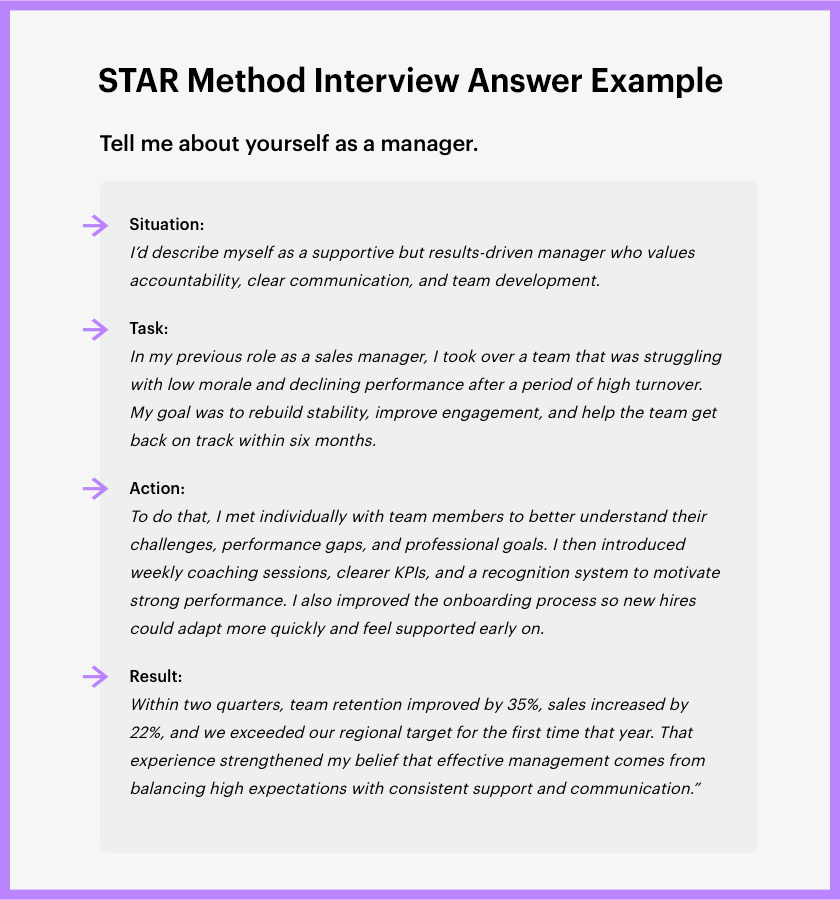
Situation:
I’d describe myself as a supportive but results-driven manager who values accountability, clear communication, and team development.
Task:
In my previous role as a sales manager, I took over a team that was struggling with low morale and declining performance after a period of high turnover. My goal was to rebuild stability, improve engagement, and help the team get back on track within six months.
Action:
To do that, I met individually with team members to better understand their challenges, performance gaps, and professional goals. I then introduced weekly coaching sessions, clearer KPIs, and a recognition system to motivate strong performance. I also improved the onboarding process so new hires could adapt more quickly and feel supported early on.
Result:
Within two quarters, team retention improved by 35%, sales increased by 22%, and we exceeded our regional target for the first time that year. That experience strengthened my belief that effective management comes from balancing high expectations with consistent support and communication.”
Why this answer is strong
- Follows the STAR method with a clear situation, actions, and results.
- Uses specific leadership examples instead of generic self-descriptions.
- Includes measurable achievements (retention growth, sales increase, target achievement).
- Demonstrates key managerial skills like coaching, communication, and performance management.
- Sounds professional, authentic, and results-driven.
In many interviews, hiring managers typically evaluate not just what you achieved, but how you explain your decision-making, leadership approach, and impact on team performance.
Prepare metrics and leadership examples
Hiring managers want to see measurable results. Prepare examples that highlight achievements such as improving team productivity, increasing sales, reducing costs, improving employee retention, or successfully managing projects. Using numbers and data makes your answers more credible and impactful.
Practice situational management scenarios
Manager interviews often include situational and behavioral questions about conflict resolution, employee performance, delegation, and decision-making. Practice answering realistic management scenarios so you can respond confidently and professionally during the interview.
Strong storytelling helps hiring managers better understand your leadership style, decision-making process, and ability to handle real workplace situations confidently and professionally.
Related: How to Use Storytelling to Ace Job Interviews in 2026
In many interviews, what really separates strong candidates from weaker ones is how clearly they think, how simply they explain their experience, and whether they can link what they did to real results.
FAQ
What are the most common manager interview questions?
The most common manager interview questions focus on leadership experience, team management, decision-making, and conflict resolution. Employers typically ask about motivating employees, delegating responsibilities, handling underperformance, managing change, and delivering results. Many questions are behavioral and require candidates to provide examples of how they handled real management situations.
How do you answer management interview questions effectively?
The most effective answers include clear examples of past leadership experiences and measurable results. Many candidates use the STAR method (Situation, Task, Action, Result) to structure responses. This approach helps demonstrate how your decisions, communication, and leadership skills contributed to improved team performance or successful project outcomes.
What are the biggest mistakes to avoid in a managerial interview?
Common mistakes include providing vague answers, failing to demonstrate leadership experience, and not supporting responses with real examples. Candidates should also avoid focusing only on personal achievements instead of team results. Employers expect managers to show accountability, problem-solving ability, and a clear understanding of team leadership.
 Privacy Protected
Get a Free Expert Resume Review
file here or click to upload
Thank You