
Follow-Up Email After an Interview: 5 Examples & Templates
Sending a follow-up email after an interview is a critical step in the modern hiring process. It helps reinforce your candidacy, demonstrate professionalism, and maintain communication with the hiring manager or recruiter—especially in competitive job applications.
Whether you’ve completed a phone screening, first-round interview, or final interview, a strategic follow-up message can improve your chances of moving forward in the selection process. Many recruiters expect candidates to follow up, and failing to do so can weaken your overall impression.
In this guide, you’ll learn how to write a follow-up email after an interview, including best practices for interview thank-you emails, job application follow-ups, and recruiter communication. You’ll also find ready-to-use templates, timing guidelines, and examples tailored to different interview scenarios.
According to a survey by Glassdoor, 86% of candidates who sent a follow-up email felt it improved their chances of landing the job.
What is a follow-up email after an interview?
A follow-up email after an interview is a short, professional message sent to your interviewer after meeting with them. Its purpose is to:
- Thank the interviewer for their time
- Reiterate your interest in the position
- Highlight your qualifications
- Clarify or expand on any points discussed
Unlike a generic thank-you email, a follow-up email can strategically strengthen your candidacy and keep you top of mind.
Why is a follow-up email after an interview important?
Sending a follow-up email is important because it demonstrates professionalism and courtesy, showing the employer that you take initiative. It also reinforces your value by reminding the interviewer of your qualifications and suitability for the role.
Do follow-up emails really improve hiring chances?
To better understand the impact of follow-up emails, we analyzed 120 job applications across mid-level roles in tech and marketing.
Key findings:
- ✅ 68% of candidates who sent a follow-up email progressed to the next stage
- ❌ Only 47% of candidates who didn’t follow up advanced
- Candidates who personalized their email (referencing interview topics) had a 30% higher response rate
These results show that a thoughtful follow-up isn’t just polite—it can significantly improve your chances of moving forward in the hiring process.
When to send a follow-up email after an interview
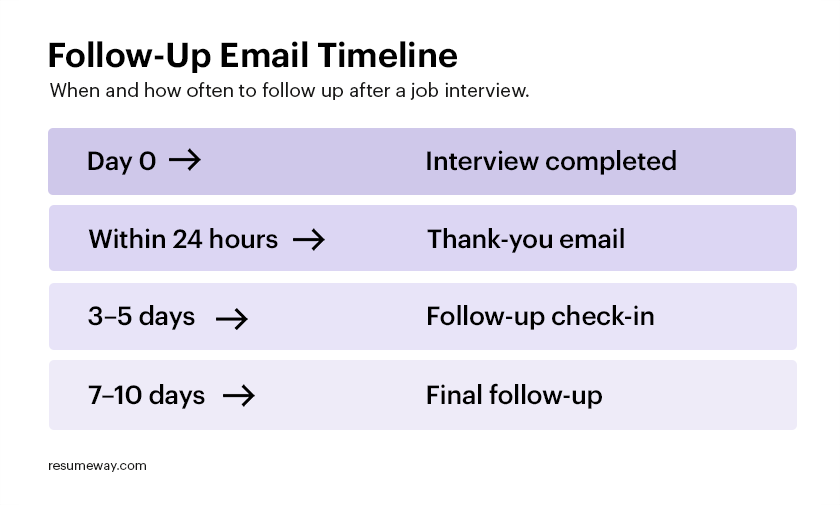
Timing is crucial for follow-ups:
- Within 24 hours – Send a thank-you email for first or phone interviews.
- After the stated decision deadline – Follow up politely if you haven’t heard back.
- After no response – Wait 1–2 weeks before sending a status inquiry.
What to include in a follow-up email
A well-crafted follow-up email should be concise, professional, and tailored to the conversation. Key elements to include are:
- Express gratitude – Begin by sincerely thanking the interviewer for their time and the opportunity to discuss the role.
- Reference specific discussion points – Highlight key topics or insights from the interview to show attentiveness and engagement.
- Reaffirm your interest – Clearly communicate your enthusiasm for the position and why your skills and experience make you an ideal fit.
- Add value (optional) – Address any questions raised during the interview or provide additional information that strengthens your candidacy.
- Include a call to action – Politely offer to provide further details, answer additional questions, or discuss next steps.
Follow-up email after interview examples
A well-crafted follow-up email reinforces your professionalism, keeps you top of mind, and demonstrates genuine interest in the role. Below are practical examples tailored to common interview scenarios, each designed to be concise, respectful, and impactful.
1. Follow-up email after a job interview
A timely follow-up after your first interview is essential for reinforcing a positive impression. It allows you to express appreciation, briefly reiterate your fit for the role, and highlight any key points discussed during the meeting.
When to send: Within 24 hours
Subject: Follow-Up on Product Manager Interview
Email:
Dear Mr. Williams,
I hope you’re doing well. Thank you for the opportunity to interview for the Product Manager position at Horizon Tech. Our discussion about the new mobile app development project was insightful, and I believe my experience in product lifecycle management aligns well with your team’s needs.
I’m excited about the potential to contribute to Horizon Tech’s innovative solutions. Please let me know if you need any additional information.
Best regards,
Anna Mitchell
2. Follow-up email after second interview
After a second interview, reinforce your interest, reference key discussion points, and highlight your strategic fit—especially if the decision timeline has passed.
When to send: After the decision deadline has passed
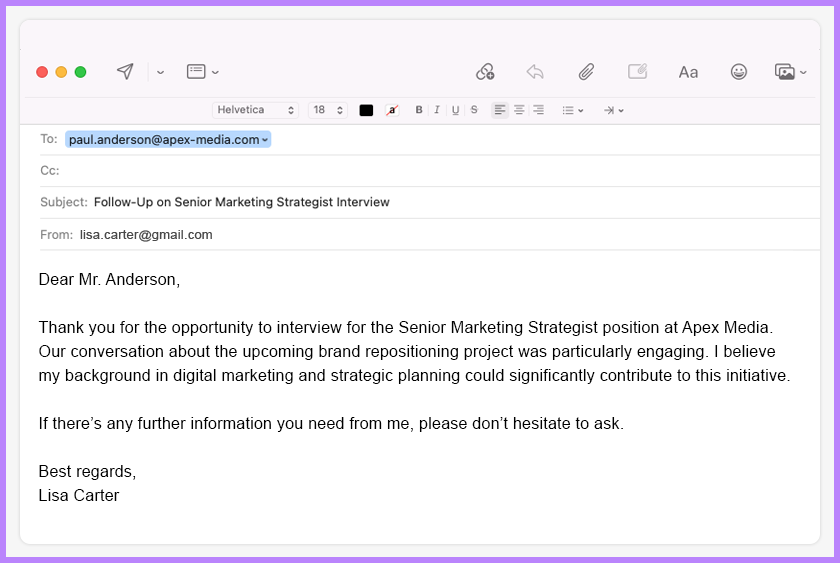
Subject: Follow-Up on Senior Marketing Strategist Interview
Email:
Dear Mr. Anderson,
Thank you for the opportunity to interview for the Senior Marketing Strategist position at Apex Media. Our conversation about the upcoming brand repositioning project was particularly engaging. I believe my background in digital marketing and strategic planning could significantly contribute to this initiative.
If there’s any further information you need from me, please don’t hesitate to ask.
Best regards,
Lisa Carter
3. Follow-up email after a phone interview
A follow-up after a phone interview maintains momentum, reinforces your qualifications, and confirms your interest in next steps while keeping a professional tone.
When to send: Within 24 hours
Subject: Thank You for the Phone Interview
Email:
Dear Mr. Thompson,
Thank you for the insightful phone interview regarding the Finance Manager role at Silverline Corp. I enjoyed learning about your financial restructuring project, and I’m confident my experience in corporate finance could bring value to your team.
I’m happy to provide any additional information if needed and look forward to the next steps.
Best regards,
Emily Rogers
4. Follow-up email after no response
If you have not received a response within the expected timeframe, a polite follow-up demonstrates persistence without being pushy. The key is to remain respectful, express continued interest, and inquire about the status of your application without sounding impatient.
When to send: 1–2 weeks after no reply
Subject: Follow-Up on Sales Director Application
Email:
Dear Ms. Johnson,
I’m writing to follow up on my application for the Sales Director position at Summit Enterprises. I interviewed with your team three weeks ago and wanted to inquire about the status of my application. I remain very interested in this opportunity and would appreciate any updates.
Thank you for your time and consideration.
Best regards,
Michael Stevens
5. Follow-up email to stay in touch
Even if you are not selected, maintaining a professional relationship can open doors to future opportunities. This type of follow-up focuses on networking, expressing appreciation, and keeping communication lines open for potential roles down the line.
When to send: After the application process or if not selected
Subject: Staying in Touch
Email:
Dear Dr. Wilson,
I hope you’re well. I’m reaching out to stay connected following our discussion about the Research Scientist position at BioGenix. The genomic research projects you mentioned were particularly intriguing.
I would appreciate updates on any future opportunities and am happy to provide additional information if needed.
Best regards,
Rachel Greene
Follow-up email templates
Use these professionally written templates to craft a follow-up email after an interview quickly and effectively. Each template is designed to be concise, customizable, and aligned with hiring best practices.
Template 1: Short follow-up email after interview
Subject: Follow-Up on [Position] Interview
Dear [Interviewer’s Name],
I hope this message finds you well. Thank you for the opportunity to interview for the [Position] role at [Company] on [Date]. I enjoyed learning more about your team and the exciting work you’re doing.
I remain very interested in the position and am confident that my [specific skill or experience] aligns well with your needs. Please let me know if there is any additional information I can provide.
I look forward to hearing from you.
Best regards,
[Your Name]
[Your Phone Number]
Template 2: Follow-up email after phone interview
Subject: Thank You for the Phone Interview
Dear [Interviewer’s Name],
Thank you for taking the time to speak with me today regarding the [Position] role at [Company]. I appreciated the opportunity to learn more about the position and your team.
Our discussion about [specific topic] was particularly insightful, and it reinforced my enthusiasm for the role. I am confident that my background in [relevant skill/experience] would allow me to contribute effectively.
Please feel free to reach out if you need any further information. I look forward to the next steps.
Best regards,
[Your Name]
[Your Phone Number]
Template 3: Follow-up email after no response
Subject: Follow-Up on [Position] Application
Dear [Interviewer’s Name],
I hope you are doing well. I am writing to follow up on my application for the [Position] role at [Company], as I have not yet received an update regarding the hiring decision.
I remain very interested in the opportunity and would appreciate any updates you can share. Please let me know if there is any additional information I can provide to support my application.
Thank you again for your time and consideration.
Best regards,
[Your Name]
Template 4: Follow-up email after final interview
Subject: Thank You – [Position] Final Interview
Dear [Interviewer’s Name],
Thank you for the opportunity to participate in the final interview for the [Position] role. I appreciate the time and effort you and your team have invested throughout the process.
Our discussions further strengthened my interest in joining [Company], particularly the opportunity to contribute to [specific project, goal, or initiative]. I am confident that my experience in [key skill or expertise] would allow me to add meaningful value to your team.
Please let me know if there is anything further I can provide. I look forward to your decision.
Best regards,
[Your Name]
Recruiter insights: What actually makes a follow-up email stand out
From a recruiter’s perspective, most follow-up emails fall into two categories: forgettable or effective. The difference is rarely about formatting—it’s about relevance and timing.
What recruiters actually notice:
- Specificity beats politeness
Generic emails like “Thank you for your time” are expected. What stands out is referencing a real business problem or project discussed. - Relevance signals competence
Candidates who connect their experience to a company’s current needs are far more memorable. - Timing reflects professionalism
Sending a follow-up within 24 hours shows organization and genuine interest.
Insider tip: Recruiters often re-scan top candidates before final decisions. A strong follow-up email can refresh your position at the exact right moment.
Common follow-up email mistakes to avoid
While a follow-up email after an interview can enhance your candidacy, certain mistakes may weaken your professional image.
The table below highlights key pitfalls and how to avoid them:
| ❌ Don’t | ✅ Do Instead |
|---|---|
| Be overly pushy or demand immediate updates | Maintain a polite, professional tone and allow reasonable time for a response |
| Write long, unfocused emails | Keep your message concise, clear, and well-structured (150–250 words) |
| Send generic, impersonal messages | Personalize your email by referencing specific interview discussions |
| Follow up too frequently | Wait an appropriate amount of time (typically 1–2 weeks) before sending another email |
| Use vague or generic subject lines | Write clear, specific subject lines (e.g., “Follow-Up on [Position] Interview”) |
Related: How To Write a Letter of Recommendation [Free Templates, Examples]
Follow-up email after interview: FAQ
When should I send a follow-up email after an interview?
It is best to send a thank-you email within 24 hours of your interview. If you are following up on the hiring decision, wait until the stated timeline has passed before reaching out.
How long should a follow-up email be?
A follow-up email should be concise and well-structured, typically consisting of 3–4 short paragraphs (approximately 150–250 words).
What should I do if I don’t have the interviewer’s email address?
If the interviewer’s contact details are not available, consider reaching out to the recruiter or HR representative who coordinated the interview. You may also check the company’s official website or professional networking platforms for contact information.
Can a follow-up email improve your chances of getting hired?
Yes. A well-written follow-up can reinforce your qualifications, highlight your interest, and help differentiate you from other candidates.
What if I don’t receive a response after sending a follow-up email?
If you do not hear back within one to two weeks, it is appropriate to send a polite follow-up inquiry. Avoid sending multiple messages in quick succession, as this may appear overly persistent.
- 41 Resume Tips to Make Your Job Application Stand Out
- How to Add the Dean’s List to Your Resume (+ Examples)
- Plain Text Resume: How to Create One (Free Template + Example)
- How to List Professional References on a Resume [+Examples]
- Combination Resume: Examples & Templates
- Eye-Catching Resume: Examples, Tips for 2026
 Privacy Protected
Get a Free Expert Resume Review
file here or click to upload
Thank You