“What Are Your Salary Expectations?” How to Answer (2026)

One of the most challenging interview questions is “What are your salary expectations?” Answer too high and you may price yourself out of the job. Answer too low and you risk undervaluing your skills.
The key is to provide a well-researched salary range that reflects your experience, market value, and the role’s responsibilities.
In this guide, you’ll learn how to answer salary expectation questions confidently, with practical strategies, negotiation tips, and example answers for entry-level, mid-career, and senior professionals.
Key Takeways
- Research the market salary range for the role before the interview.
- Provide a salary range instead of a fixed number.
- Base your expectations on skills, experience, and industry benchmarks.
- Emphasize total compensation (bonuses, benefits, growth opportunities).
- Stay confident, flexible, and open to negotiation.
Why employers ask “what are your salary expectations”
Employers ask “what are your salary expectations?” to determine whether your desired compensation aligns with their budget and internal pay structure. Beyond numbers, this question helps hiring managers assess how well you understand your market value, including your skills, experience, and relevant qualifications.
It also provides insight into whether your expectations match the responsibilities, scope, and seniority of the role. A thoughtful, well-prepared answer signals that you are professional, informed, and ready to negotiate, while an unrealistic or unprepared response may raise concerns about fit or expectations.
How to answer “what are your salary expectations” (step-by-step)
Here are some helpful tips for answering the salary expectations question during an interview:
1. Research the market salary range
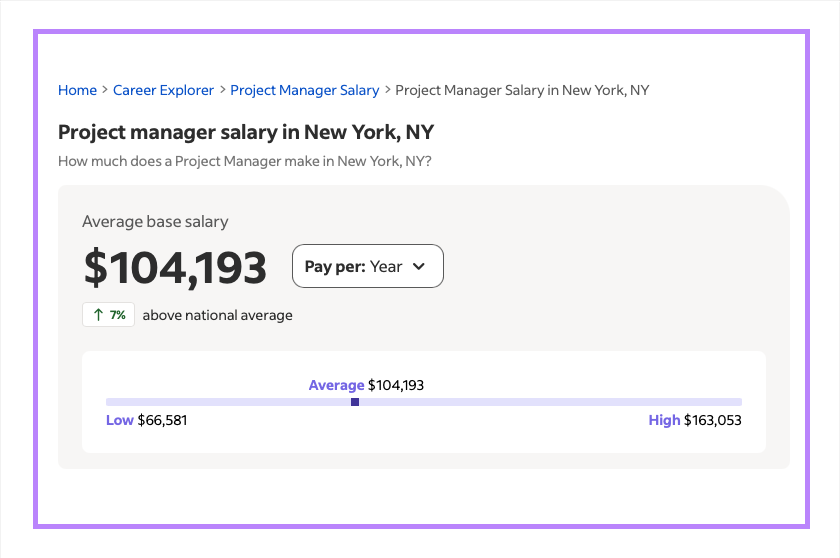
Before the interview, it’s crucial to research the average salary range for similar positions in your industry and location. This will provide you with a benchmark to assess your own salary expectations. As Lydia Franklin, Career Consultant and Salary Negotiation Coach, advises: “A well-informed candidate is a confident negotiator. Use tools like Payscale or Salary.com to understand market trends before stepping into the negotiation room.”
Here are some reliable sources for researching industry salary standards:
- U.S. Bureau of Labor Statistics (BLS): The BLS provides comprehensive data on pay and benefits for various occupations, offering valuable insights into industry salary standards.
- Payscale: Payscale offers a salary comparison and survey platform, providing validated compensation data from multiple sources to help individuals navigate market uncertainty.
- Salary.com: Salary offers a salary calculator, salary comparison, and compensation information, allowing individuals to determine their worth and negotiate effectively.
- Indeed: Indeed is one of the largest job search websites and it also provides salary information. The data on Indeed is based on the salaries reported by companies in their job postings, giving you a real-time view of what employers are currently offering.
2. Evaluate your market value
When reflecting on your skills, experience, and qualifications to justify your salary expectations, it’s essential to highlight the unique value you bring to the role. Consider the following components to articulate your value effectively:
- Relevant skills: Emphasize specific skills that are directly applicable to the role and demonstrate your ability to contribute effectively. For example, if you are applying for an accounting position, highlighting skills in analytical and problem-solving, and knowledge of enterprise resource planning software can showcase your value.
- Professional experience: Discuss your relevant professional experience and accomplishments that align with the requirements of the role. Highlight specific achievements that demonstrate your ability to deliver results and add value to the organization.
- Qualifications and certifications: If you hold any relevant qualifications or certifications that enhance your expertise in the field, be sure to mention them. This can further strengthen your value proposition and justify your salary expectations.
- Achievements: As Maria Lopez, Career Development Expert, states: “Your achievements are your strongest leverage in salary discussions. Quantify your successes whenever possible—for example, ‘increased sales by 30% in one year’ or ‘led a team that delivered a major project ahead of schedule.’” Provide specific examples of how your contributions have positively impacted previous roles, such as exceeding performance targets, leading successful projects, or implementing innovative solutions that benefited the organization.
Example: Evaluating Your Market Value for Salary Negotiation
| Component | Example (Accounting Role) | How It Strengthens Your Salary Case |
|---|---|---|
| Relevant Skills | Advanced Excel, financial analysis, ERP systems (SAP), problem-solving | Shows you can perform immediately and reduce training costs |
| Professional Experience | 5 years in corporate accounting, managed monthly close processes, handled budgets over $2M | Demonstrates proven capability and reliability |
| Qualifications & Certifications | CPA certification, Bachelor’s in Accounting | Signals credibility and expertise, justifying higher pay |
| Key Achievements | Reduced reporting errors by 25%, improved process efficiency saving 10 hours/month | Provides quantifiable proof of value (very persuasive)g |
| Unique Value Proposition | Experience implementing new accounting software across teams | Positions you as a high-impact hire, not just a candidate |
| Market Benchmark | Average salary: $65K–$80K (based on market research) | Anchors your expectations in data, not opinion |
3. Avoid giving a number too early
Rather than providing a specific salary number, redirect the discussion by expressing interest in learning more about the role, the company’s compensation structure, and the overall benefits package. As Thomas Greene, Human Resources Specialist, explains: “If you’re asked about salary early in the interview, redirect the focus to your skills and how you can contribute to the company. This approach demonstrates that you’re not solely money-focused.”
By showing interest in the full compensation package—including benefits, bonuses, and other incentives—you demonstrate a balanced approach and eagerness to align with the organization’s offerings.
Here are a few examples of how you can redirect the conversation:
1. Inquire about the company’s compensation structure
Ask about the company’s philosophy or structure to understand how salaries are determined. For example, you might say:
“Could you provide some insights into the company’s compensation structure? I’m interested in understanding how the company values and compensates its employees based on their skills and contributions.”
2. Highlight your value proposition
Instead of focusing on salary, emphasize your skills, experience, and achievements. For example, you could say:
“Based on my experience in XYZ and my track record of achieving XYZ results, I believe I can bring significant value to the company. I’m excited to discuss how my skills and expertise can contribute to the success of the team.”
4. Provide a realistic salary range
When sharing your salary expectations, it is often beneficial to offer a salary range instead of a specific figure. This approach allows for negotiation and demonstrates flexibility during the hiring process. Additionally, it is important to provide a rationale for why you have landed on that range, highlighting the research you have conducted and emphasizing the skills and experience that make you a strong fit for the position. Here is an example of how you can approach this situation:
Sample Answer
“I believe a competitive salary that aligns with my qualifications and experience would be appropriate. After conducting research and considering the requirements of the role, I would expect a salary range of $65,000 to $75,000. However, I understand that salary is just one aspect of the overall compensation package. I am genuinely interested in exploring other benefits and opportunities for growth within the company. I am enthusiastic about the potential of joining your team and look forward to continuing the conversation regarding compensation.”
5. Consider total compensation
When considering salary expectations, it’s crucial to take into account the total compensation package. This includes not only the base salary but also other benefits such as bonuses, stock options, healthcare, retirement plans, and work-life balance. These factors contribute significantly to the overall value of the compensation package.
Example answers to “what are your salary expectations”
Negotiating your salary in a job interview is vital for securing fair compensation that aligns with your skills and experience. Here are some examples of salary negotiation responses based on different scenarios:
1. Example answer (general)
2. Example answer if recruiter asks early
Response: “At this stage, I’d love to learn more about the role and the expectations before discussing specific numbers. Once I have a better understanding of the responsibilities and the team’s goals, I’d be happy to discuss a salary range that aligns with the position and market standards.”
3. Example answer if asked on job application
4. Example answer when salary is negotiable
Remember, when negotiating your salary, it’s important to maintain a professional and respectful tone. Clearly communicate your value, be prepared to justify your desired salary based on your skills and experience, and be open to exploring other aspects of the compensation package if necessary.
Salary expectation answers by career level
Here are a few more examples of how you can respond to the question “What are your salary expectations?” based on different career stage:
Entry-level candidates
Sample Answer
“As a fresher, my main priority is to gain valuable experience and contribute to the growth of the company. While salary is important, I am more focused on the learning opportunities and professional development that this role can offer. I am open to discussing a salary that is fair and competitive within the industry standards for this position”
Sample Answer
“I understand that as a fresher, my salary expectations may differ from someone with more experience. My primary goal is to establish a strong foundation in my career and learn from experienced professionals. I am willing to consider a salary that reflects the market value for this role and provides a fair compensation for my skills and contributions.”
Mid-career professionals
Sample Answer
“I have [X years of experience] in [industry/field] and have consistently delivered exceptional results in my previous roles. Considering my expertise and the level of responsibility associated with this position, I would expect a salary range of [desired range]. However, I am open to discussing the details of the compensation package, including bonuses, equity, and other benefits that align with the company’s culture and values. I believe that a fair and competitive compensation package is essential to attract and retain top talent in today’s market.”
Salary professionals / executive
Sample Answer
“Based on my extensive experience and proven track record as a senior-level executive, I would anticipate a salary range of [desired range] for this position. This range takes into account the industry standards, the scope of responsibilities, and the value I can bring to the organization. I am also open to discussing additional benefits and incentives that can further enhance the overall compensation package. I believe in the importance of fair compensation that recognizes the contributions and expertise of senior-level executives.”
Common salary expectation mistakes to avoid
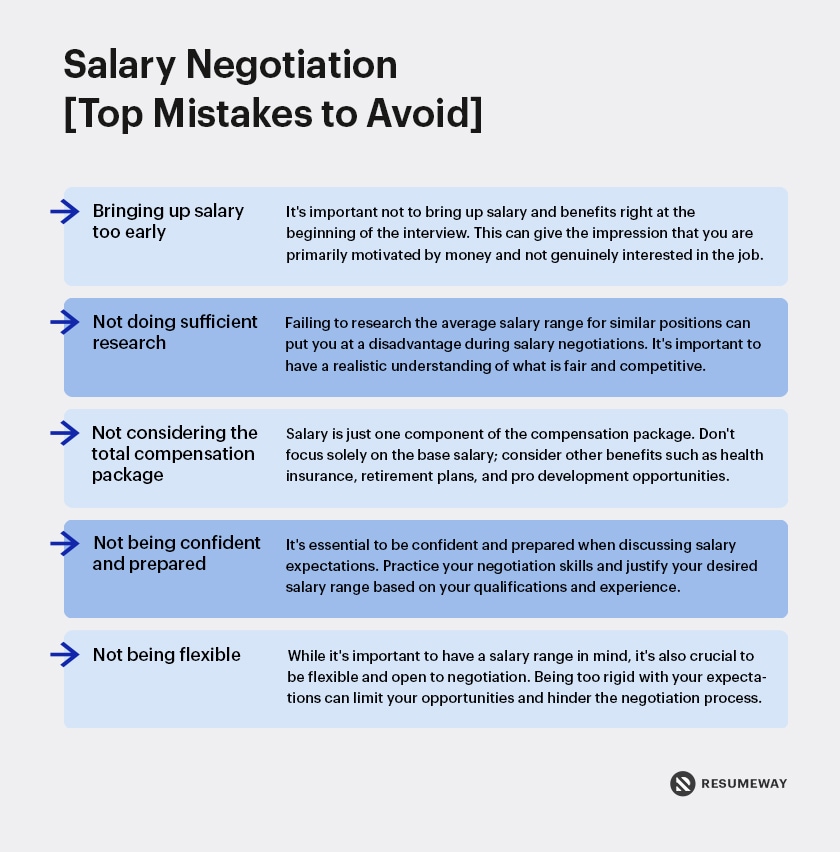
- Bring up salary too soon: Avoid discussing pay in early interview stages unless prompted by the interviewer.
- Focus solely on salary: Consider the entire compensation package, including benefits and growth opportunities.
- Appear unprepared: Lack of preparation can undermine your credibility and limit your negotiation power.
- Be inflexible: Rigid expectations can alienate employers and reduce your chances of securing an offer.
- Undervalue yourself: Avoid stating a range or number that doesn’t reflect your worth and market data.
Salary negotiation tips from recruiters
Recruiters and hiring managers see salary negotiations every day. Here are a few expert tips that can help you handle the conversation more strategically:
- Research the market first. Use salary data from sources like Glassdoor, Payscale, or the Bureau of Labor Statistics to understand the typical pay range for the role.
- Let the employer share the range first when possible. This prevents you from anchoring the negotiation too low.
- Use a salary range instead of a fixed number. A range shows flexibility and leaves room for negotiation.
- Support your expectations with achievements. Highlight measurable results such as revenue growth, cost savings, or successful projects.
- Consider the full compensation package. Benefits, bonuses, remote flexibility, and career development opportunities can significantly increase total compensation.
Tip: Recruiters often recommend staying confident but flexible. Candidates who clearly explain their value while remaining open to discussion tend to negotiate stronger offers.
FAQ
How to give a range instead of a single answer to “what are your salary expectations?”
When asked, “What are your salary expectations?” it’s often better to give a salary range rather than a single number. A range provides flexibility and shows that you’re reasonable while still setting boundaries. Start by researching the market rate for your role, industry, and location, then choose a range where the bottom is your minimum acceptable salary and the top is slightly higher than your target.
What if the employer asks for a specific number?
If an employer asks for a specific number, it’s usually best to provide a salary range instead of a fixed figure. A range shows that you have researched the market while leaving room for negotiation. Make sure your range reflects your experience, the role’s responsibilities, and current industry salary benchmarks.
How do you answer salary expectations in an online application?
When an online application requires a salary expectation, research the average salary for the role in your location and industry. If possible, provide a reasonable salary range. If the form requires a single number, choose a mid-to-upper figure within the market range to leave room for negotiation.
Should you include salary expectations in a cover letter?
In most cases, you should avoid mentioning salary expectations in a cover letter unless the employer specifically requests it. If it is required, provide a flexible salary range rather than a fixed number and indicate that you are open to discussing the full compensation package during the interview process.
What salary range should I give?
A good rule is to provide a range that spans about 10–20%. The lower end should represent the minimum salary you would accept, while the higher end should reflect your ideal compensation based on your skills, experience, and the value you bring to the role.
Popular related posts:
- 12 Hardest Interview Questions and Best Answers
- How to Add the Dean’s List to Your Resume (+ Examples)
- Strengths and Weaknesses for Job Interviews in 2026 [Best Answers]
- Elevator Pitch for a Job Interview with Examples [2025]
- 50+ Hard Skills For Your Resume [In 2026]
- 24 Interview Questions for Managers (With Sample Answers)
 Privacy Protected
Get a Free Expert Resume Review
file here or click to upload
Thank You