The 8 Most Important Soft Skills to Include on a Resume (2026)

After reviewing thousands of modern resumes and tracking hiring trends across ATS-driven and AI-assisted recruiting, one thing is clear: soft skills only matter when they’re demonstrated with results. Communication, adaptability, leadership, and problem-solving are still critical — but listing them without context no longer works.
In this guide, you’ll learn which soft skills employers value most in 2026 and exactly how to prove them on your resume using measurable, ATS-friendly examples that hiring managers actually trust.
Best Soft Skills for a Resume in 2026
- The most important soft skills in 2026 are communication, adaptability, problem-solving, teamwork, leadership, and time management
- Employers want evidence, not traits — soft skills must be shown through actions and results
- List 3–5 role-specific soft skills, each backed by measurable outcomes
- Soft skills perform best when embedded in your experience section, not as standalone keyword
What Are Soft Skills and Why They Matter More in 2026?
Soft skills are transferable abilities that influence how you work, communicate, and solve problems. Unlike hard skills, they don’t expire — and they’re increasingly important as automation handles more technical tasks.
Based on resume audits and recruiter feedback, qualified candidates are most often rejected not for missing technical skills, but for poor communication, weak collaboration, or low adaptability — especially in fast-changing, AI-supported workplaces.
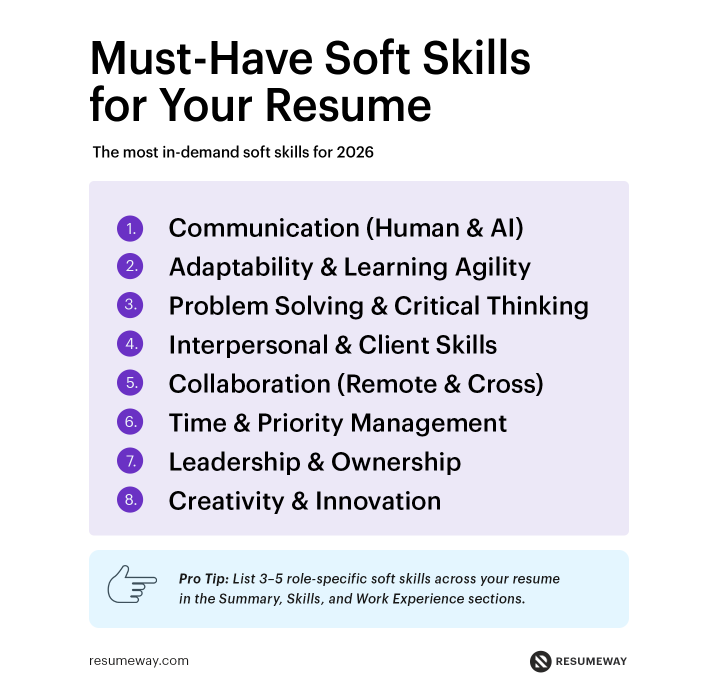
The 8 Most Important Soft Skills to Include on a Resume
1. Communication Skills
Communication is the most consistently evaluated soft skill in hiring, but in 2026 it is judged by outcomes, not claims. Recruiters look for evidence that a candidate can align stakeholders, convey information clearly, and reduce friction across teams.
For example: in the work experience section, describing how you presented weekly performance reports to senior leadership, reducing misalignment and improving project turnaround by 18% shows communication through impact rather than assertion.
2. Leadership Skills
Leadership is no longer limited to formal management roles. In 2026, employers assess leadership by looking for ownership, decision-making, and the ability to influence outcomes.
For example: in the work experience section, stating that you led a cross-functional team of six to deliver a client project two weeks ahead of schedule shows leadership through accountability and results, rather than title alone.
3. Teamwork & Collaboration
Teamwork is increasingly critical in hybrid and cross-functional environments, where employers value candidates who can coordinate across teams and resolve conflicts effectively.
For example: in the summary section, you might write: “Collaborated with cross-functional teams to streamline project workflows, improving interdepartmental efficiency by 20%” to highlight collaborative ability upfront. Alternatively, in the work experience section, describing how you worked closely with design and engineering teams to launch a product update used by 50,000+ users demonstrates collaboration through measurable results.
4. Adaptability
Adaptability reflects a candidate’s ability to respond quickly to change, learn new tools, and recover from setbacks — all increasingly vital in AI-supported workplaces.
For example: in the skills section, listing “Adapted to new CRM systems within two weeks, reducing onboarding time by 30%” signals measurable flexibility. In the work experience section, describing how you shifted project priorities mid-quarter to meet client demands without delays shows adaptability in action.
5. Problem-Solving Skills
Problem-solving is essential for candidates who can identify challenges and implement solutions independently, rather than escalating issues unnecessarily.
For example: in the summary, you might write: “Expert at identifying workflow bottlenecks and implementing process improvements that reduce errors by 25%” to establish problem-solving from the start.
6. Interpersonal Skills
Strong interpersonal skills help maintain positive working relationships, manage conflicts, and build rapport with colleagues or clients.
For example, in the skills section, listing “Empathy, diplomacy, and relationship-building” signals your relational strengths concisely. In the work experience section, stating that you maintained long-term client relationships with a 95% retention rate shows interpersonal effectiveness through measurable results.
7. Creativity
Creativity is valued across roles, not just in design, for candidates who can generate ideas, innovate processes, and approach challenges strategically.
For example: in the summary, writing: “Developed innovative onboarding processes that increased new-hire productivity within 30 days” highlights creativity upfront. In the work experience section, describing how you implemented a new marketing campaign that boosted engagement by 40% demonstrates creativity with measurable impact.
8. Time Management
Time management reflects reliability, accountability, and the ability to handle multiple priorities efficiently.
For example, in the skills section, listing “Prioritization, delegation, and deadline management” signals time management skills succinctly. In the work experience section, describing how you managed multiple client projects simultaneously while meeting 100% of deadlines demonstrates accountability and effectiveness through concrete results.
How Many Soft Skills Should You List on a Resume?
You should list 3–5 proven soft skills on your resume, as a focused selection is far more effective than long, generic lists. Choose soft skills that directly match the job description, align with the role’s seniority, and fit the company culture.
Common Soft Skills Resume Mistakes
- Listing soft skills without evidence
- Using vague phrases like “good communicator”
- Ignoring ATS keyword alignment
- Copying skills from unrelated roles
FAQ:
What are the best soft skills for a resume in 2026?
The best soft skills for a resume in 2026 are communication, adaptability, problem-solving, teamwork, leadership, and time management. Employers prioritize these skills because they show how candidates perform in fast-changing, AI-supported, and collaborative work environments. The most effective resumes don’t just list these skills—they demonstrate them through measurable achievements.
How many soft skills should you list on a resume?
You should list 3 to 5 soft skills on your resume. Fewer, well-proven skills are far more effective than long, generic lists. Each soft skill should be directly relevant to the job description and supported by examples in your work experience section.
Can soft skills replace hard skills on a resume?
No—soft skills cannot replace hard skills, but they often determine who gets hired when candidates have similar technical qualifications. Hard skills show what you can do, while soft skills show how you work. In competitive hiring decisions, strong soft skills frequently tip the scale.
How do you prove soft skills on a resume?
You prove soft skills on a resume by showing them through actions and results in your experience section. Instead of vague phrases like “strong communicator,” include outcomes such as led cross-team meetings that reduced project delays by 20%, which demonstrates real behavior rather than personal traits.
Are soft skills ATS-friendly?
Yes, soft skills are ATS-friendly when paired with role-specific context and measurable results. Applicant Tracking Systems recognize soft skill keywords, but resumes perform best when those keywords appear naturally within experience descriptions rather than in isolated skill lists.
Popular related posts:
- Strengths and Weaknesses for Job Interviews [Great Answers]
- 15 Best Skills for a Resume (With Examples)
- Thank You Email After Interview: Examples, Dos, and Don’ts
- 7 Ways to Improve Your Cover Letter Today
 Privacy Protected
Get a Free Expert Resume Review
file here or click to upload
Thank You