
Create an Effective Personal Development Plan in 7 Steps [2025]

Crafting a personal development plan is a crucial step in achieving your goals. Learn how to create a comprehensive plan in 7 steps, including self-assessment, goal setting, identifying development areas, creating an action plan, tracking progress, seeking feedback and support, and reflecting and adapting for continuous growth and improvement.
Table of contents
- What is a personal development plan?
- Who needs a personal development plan?
- 7 steps to create a personal development plan
- Step 1: Self-assessment
- Step 2: Set clear goals
- Step 3: Identify development areas
- Step 4: Create an action plan
- Step 5: Implement and track progress
- Step 6: Seek feedback and support
- Step 7: Reflect and adapt
- Common mistakes to avoid in personal development
What is a personal development plan?
A personal development plan (PDP) is an action plan that individuals can use to identify their individual goals, strengths, weaknesses, areas for improvement, and the necessary steps to achieve their goals. It is a method of focusing one’s goals into achievable steps, which helps in tracking personal development.
The plan can be aimed at education, career, personal goals, or a combination of these. It provides a clear sense of focus, helps in mapping out a path towards goals, strategizing a plan to achieve them, recording actionable steps, and setting a timeframe for completing them.
The process involves identifying strengths, setting realistic goals, planning the necessary resources and time, and taking action to work on the goals that have been set.
Who needs a personal development plan?
A personal development plan can be beneficial for a wide range of individuals, including employees, professionals, students, and anyone seeking to enhance their personal and professional growth. Here’s a breakdown of who can benefit from a personal development plan:
- Employees: Employees can use personal development plans to identify areas for improvement, set career goals, and enhance their skills. Supervisors and employees often work together to complete the development plan, but employees are ultimately responsible for taking the initiative for their professional development.
- Professionals: Professionals in various fields can utilize personal development plans to identify strengths and weaknesses, set career objectives, and enhance their leadership and personal skills through activities such as formal training, 360-degree feedback, mentoring, and coaching.
- Students: Students can benefit from personal development plans to set academic and personal growth goals, identify areas for improvement, and develop skills that will be valuable in their future careers.
- Individuals seeking personal growth: Anyone interested in self-improvement, self-awareness, and achieving personal goals can use a personal development plan to focus on their internal state, identify their values and beliefs, and work on weaknesses while playing to their strengths.
Related: 7 Self-Improvement Tips for Personal Growth and Success
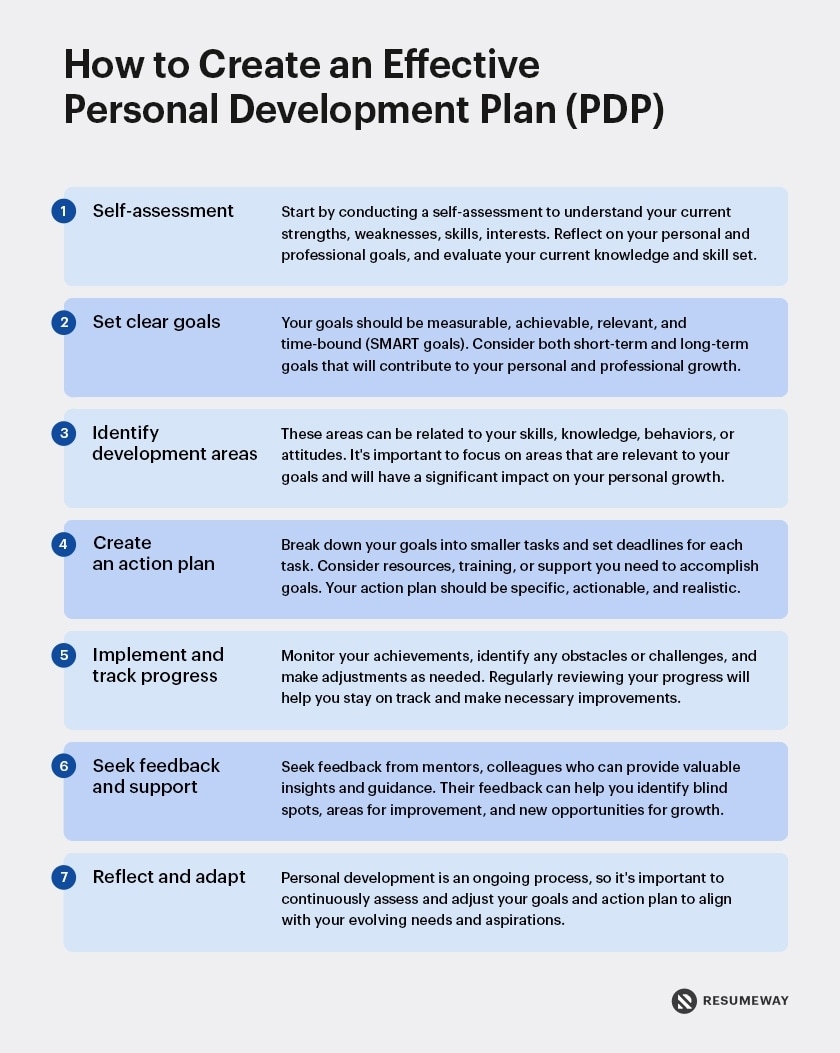
7 steps to create a personal development plan
Creating an effective personal development plan is crucial for anyone looking to grow and improve themselves. Here are 7 key steps to consider when creating your personal development plan:
Step 1: Self-assessment
Begin by evaluating your strengths, weaknesses, opportunities, and threats. Consider both short-term and long-term aspirations to identify areas for growth and set realistic objectives.
- Strengths: These are your positive attributes, such as leadership, communication skills, creativity, adaptability, or specific technical expertise.
- Weaknesses: Areas where improvement is needed, such as skills gaps, emotional intelligence, time management, or public speaking.
- Opportunities: External factors that can help you achieve your goals, such as career advancement, skill-building opportunities, networking, or trends in your industry.
- Threats: Challenges that might hinder progress, such as economic changes, industry shifts, or personal obstacles.
This self-assessment provides clarity on where you are now and where you want to go, forming a solid foundation for your personal development plan.
Step 2: Set clear goals
Research shows that employees who set specific goals are 60% more likely to achieve them (Zenger/Folkman study).
Now that you’ve identified your starting point, it’s time to establish clear, actionable goals. Use the SMART framework—goals should be Specific, Measurable, Attainable, Relevant, and Time-bound. These goals will serve as your roadmap, keeping you focused and motivated.
- Short-term goals: Typically set for 1-2 years, such as acquiring a new certification or improving time management.
- Long-term goals: Set for 3-5 years or more, such as career advancement, launching a business, or achieving major personal milestones.
Step 3: Identify development areas
Based on your self-assessment and goals, identify the areas where you need to develop. This could be acquiring new skills, improving emotional intelligence, enhancing leadership abilities, or simply working on your personal well-being. Be honest with yourself and prioritize the areas that will have the most impact on your overall growth.
- Acquiring new skills: Identify specific skills that are crucial for your short-term and long-term goals, such as project management, public speaking, or leadership training.
- Improving emotional intelligence (EQ): Enhancing emotional intelligence can significantly impact personal and professional relationships, job satisfaction, and overall well-being. This includes developing skills in self-awareness, self-regulation, social awareness, and social skills.
- Enhancing leadership abilities: If your long-term goals involve attaining a leadership position, focus on developing leadership qualities, decision-making skills, and the ability to inspire and motivate others.
- Working on personal well-being: Achieving a better work-life balance, reducing stress, and enhancing overall well-being can contribute to your personal development and long-term success.
Step 4: Create an action plan
Once you know what you want to achieve and the areas you need to develop, create an action plan. Break down your goals into smaller, actionable steps and set deadlines for each. Identify resources, courses, mentors, or support systems that can help you along the way.
- Determine your objectives: Clearly define what you want to achieve and the areas you need to develop. This could be related to personal growth, career advancement, skill enhancement, or any other aspect of your life that you want to improve.
- Break goals into smaller steps: Once you’ve identified your objectives, break them down into smaller, manageable steps. This makes your goals more achievable and helps you track your progress more effectively.
- Set deadlines: Assign realistic deadlines to each of the smaller steps. This creates a sense of urgency and aids in maintaining your focus.
Example: Goal: Enhance leadership skills in team management.
- Step 1: Complete a leadership development course (e.g., “Leading Teams” on Coursera) within 3 months.
- Step 2: Lead a small team project at work, setting clear goals and timelines.
- Step 3: Schedule monthly feedback sessions with your mentor or supervisor to improve your leadership approach.
- Step 4: Reflect on the course and project, noting successes, challenges, and lessons learned for future growth.
Step 5: Implement and track progress
Set aside time to work on your development goals, and regularly review your plan to ensure you’re on track. Be flexible and open to modifying your plan as necessary.
- Put your plan into action: Allocate dedicated time to work on your development goals. Regularly working on your action plan is essential for making tangible progress.
- Regularly review your plan: Set aside time to review your action plan regularly. This allows you to assess your progress, identify any challenges, and make adjustments as needed.
- Be flexible and willing to adjust: Flexibility is key. Be open to making adjustments to your plan as required. Circumstances may change, and being adaptable allows you to refine your approach and stay focused on achieving your objectives.
To enhance leadership skills, set aside 30 minutes each week to reflect on your leadership experiences. Use a journal to track how effectively you managed team conflicts, assess improvements in your communication, and identify areas for further growth.
Step 6: Seek feedback and support
Seeking feedback and support from mentors, colleagues, or friends is crucial for personal and professional growth. Their perspectives can offer valuable insights, help individuals stay accountable, and provide guidance in setting and achieving goals. Mentors, in particular, play a significant role in encouraging and enabling another person’s professional or personal development by helping them focus their efforts and set goals
Example:
After completing a leadership course, ask your mentor for feedback on how you’re applying the skills at work. Their perspective will help you refine your approach and keep you accountable.
Step 7: Reflect and adapt
Reflecting on your progress, celebrating achievements, learning from setbacks, and using this reflection to adapt your plan and make necessary changes are essential components of a successful personal development journey. This dynamic approach ensures that you stay aligned with your evolving goals and aspirations, and it empowers you to make continuous progress.
Example:
After leading a team project, reflect on what worked well and what didn’t. If you struggled with time management, adapt your action plan by focusing more on setting realistic deadlines and delegating tasks more effectively next time.
Related: 8 Effective Ways to Practice Self-Care at Work
Common mistakes to avoid in personal development
Mistake 1: Setting unrealistic goals
Avoid setting unrealistic goals, which can lead to feeling overwhelmed and discouraged. Instead, focus on specific, attainable, and time-bound goals aligned with your long-term vision. Break larger goals into smaller milestones to monitor advancement and acknowledge accomplishments throughout the journey.
Mistake 2: Not seeking feedback
Feedback is essential for personal growth. Not seeking feedback from others can deprive you of valuable insights and perspectives for improvement. Embrace constructive criticism to encourage self-awareness and continuous improvement, aiding in personal and professional growth.
Mistake 3: Comparing yourself to others
Each personal development journey is unique. Comparing yourself to others can lead to feelings of inadequacy and self-doubt. Focus on your own progress, celebrate accomplishments, and learn from setbacks. Embrace your uniqueness and stay focused on personal goals to nurture your development journey.
Mistake 4: Not reflecting on progress
Regularly reflecting on your progress is crucial for personal development. Failure to reflect can result in a lack of direction and missed growth opportunities. Reflect to assess achievements, challenges, and areas for improvement, and adjust goals and strategies as needed to stay aligned with your aspirations. Dedicate time for introspection and self-assessment to gain valuable insights for personal development and overall well-being.
Related: Career Satisfaction: 6 Strategies to Achieve Your Success
Personal development plan FAQ
Q1: Why is personal development important?
A: Personal development is important because it allows individuals to assess their own personal qualities and skills. It helps them set goals, improve themselves, and reach their full potential .
Q2: How can I create a personal development plan?
A: Creating a personal development plan involves self-reflection and improvement. It is a written account that doubles as a detailed action plan used to fulfill academic, personal, or career-based goals. It helps individuals establish their aims, recognize their strengths and weaknesses, and identify areas for improvement.
Q3: What are some common questions to consider when creating a personal development plan?
A: When creating a personal development plan, it can be helpful to ask yourself the following questions:
- What are my goals and aspirations?
- What are my strengths and weaknesses?
- What skills do I need to develop?
- What steps can I take to achieve my goals?
- How will I measure my progress?
- What resources or support do I need?
- How will I stay motivated and accountable?
- How will I overcome obstacles or challenges?
- How will I celebrate my achievements?
Popular related posts:
 Privacy Protected
Get a Free Expert Resume Review
file here or click to upload
Thank You